We Be Elk Hunters
(but not elk shooters)
David's Story 2006:
The Sunrise Silhouette
First posted November 3, 2006
Last updated November 8, 2006
Day Three

Day Three, October 11
Craig wakes us up in the usual fashion: shaking the tent like a banshee and yelling at us to get up. We turn on the new tent LED lantern (quite nice) and dress. It is cold but above freezing, and windy but not too bad. When we get to the Cook Tent, Sandy is up and warming her feet at the propane space heater, a great idea and possibly the best thing Sandy had for staying warm. It was used in the Cook Tent, the camper, and the truck during daytime hunts. I make a lunch, so I can stay out all day if I want to.
The mud dictates where we hunt. Some areas we can't access at all, some are so muddy we don't want to damage the roads. I am going to have to do some hiking to access the area I want to hunt. I have gotten my last two in Waterfall Canyon, west fork, from the north rim. I want to head out there, but cannot drive near the north rim. I will have to come in from the south, then approach the eastern fork of the canyon from the east.
Bill drives me out to the road and I open the gate for him. Lots of mud that I have to step in and the lock is so stiff you need the key to both open and latch it. Bill heads off.
I walk 100 yards to my rental SUV and head down 503 to Brown's Hill Road. There is thick fog and I need my map and GPS to navigate. Lots of mud, some evidence that previous vehicles went into slides and in one area went off the road. I drive slowly, park just inside the Red Gate, at the southern limit of the Ranch. The road is too muddy (the beginning of the road has some gargantuan mud holes), so I hoof it in, about a mile to a mile and half. My plan is to approach the east fork of Waterfall Canyon from the east, starting at the Waterfall and moving north toward Buck Ridge. I have hunted this area, the east fork, from the east rim once but I was 800 yards north.
My path takes me along a greensward, which is what we call areas of grass that are free of sage. They usually occur in the bottom of draws. I go along, toward The Dam, and find a cow path. It is worn about 8 inches below the level of the surrounding soil. There is one tree, a serviceberry, about 10 feet tall, and I use it as a landmark as I walk. It turns out to mark a bend in the fenceline that I need to pass, so I head that way. Some deep sage, about chest high, and I see several deer. They have usually already seen me, but are still checking me out, so if they had been shooters, I would have a chance. They usually watch me for a while then move out, so I would have a lot of time for a shot. But of course, shooters would be more skittish.
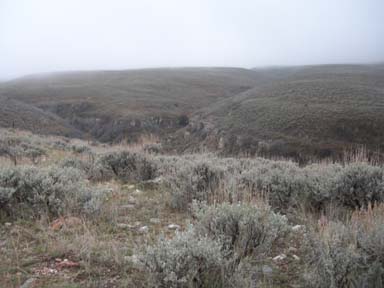
I see the land drop away and I come up to the east rim, overlooking several side canyons. I think I am looking at The Waterfall, but I have since learned from Ted that this is a lesser waterfall. A large group of mulies, about 10, only does and spikes, moves out from the ridge in the intermediate foreground on the left, in the photo below.
The low sage does not offer much concealment, so I crouch over as I move to the rim and do a lot of glassing from a kneeling position. Eventually I can see all the way to the bottom. The day has dawned, still foggy and cold, wind picking up.
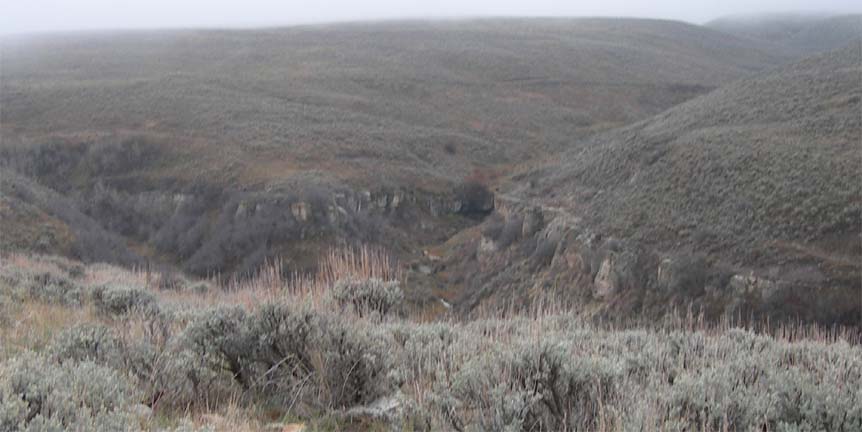
There is a lot of good cover in the creek bottom and just below and above the cliffs, but I see absolutely nothing. The canyon bottom would not allow easy escape up the canyon, and any deer would be trapped by the cliffs. I don't know if this would effect them or not, but I see nothing in the bottom, despite the luxuriant foliage. I can hear the waterfall but not see much in the way of actual falling water, just a small dribble. I suspect in retrospect the falls was out of my sight to the left. The horizon in the above photo is out of bounds for us.
I sit here and study the hillside for a while, hoping to find something lying behind a sage or serviceberry. Nada.
I back up 25 yards and move north, to peek into the canyon to my right. Deeper sage gives me better cover and I head for a serviceberry, pausing often on knees to binoc the far side as it comes into view. There is a great ravine to my right with great cover, but I see nothing on this side.
I glass the far side, not yet at the serviceberry, and see some horns. There is a buck, fair size, sitting under a serviceberry, fairly low down the hillside. He hasn't seen me. I get out the spotting scope and measure him. Not a shooter. He is a four pointer but the forks are about only 4" and not much mass and modest width. My interest in now much higher, as this is the first real set of horns I have seen this trip. I move forward very cautiously, keeping screened as best as I can by sage. I study him and decide definitively that he is not a shooter. I creep up to the serviceberry and study him as well as the hillside. Nice cover, large sage, scattered trees, and some groves of aspen, plus a ridge I cannot see over at the bottom. There are a number of does with fawns, one set spies me but I don't move and they can't figure me out. The resting buck moves his head now and again, so I get a chance to study his antlers. Still not a shooter.
I spend a couple of hours here, liking the view. I can see the Stone House and the bowl beyond, some deer working there, one has antlers but nothing to write home about or need to get closer for a view. There are deer browsing the north rim east of The Promentory, nothing big. I can see Buck Ridge, nothing. The wind is very strong, here just below the rim, and blowing in my face. I am not really cold. I have on my insulated wool pants but no long johns; a silk undershirt, wool shirt, plus down vest but no down jacket; my cashmere scarf and a wool hat; a camo waterproof uninsulated shell and fingerless gloves. I hunker down to get out of the wind. I am not cold, but I am constantly fiddling with my hood, hat, or scarf to keep as warm as I can. The wind is oppressive after a few hours.
I decide to leave, head back to the car and camp for a midday break. One last glassing shows a buck come over the far ridgetop, and my plans get changed mighty fast. He has horns, nothing great, but in a moment he is joined by another, then another. Spotting scope shows that none are shooters, but the wind makes it hard to count points.
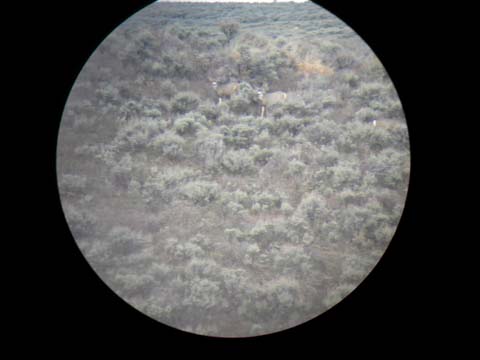
They look around but never see me. I am very well concealed behind some sage and a serviceberry is just to my left, and I am down low. I study them.
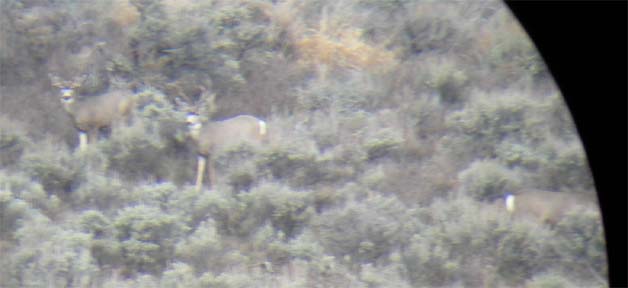
Their white butts show up very well, so I christen them the Butt Brothers. I watch them as well as the resting buck for a while.
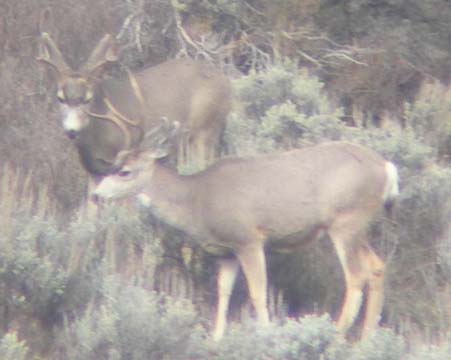
The Butt Brothers feed for a while then lie down. After another 30 minutes, with nothing more showing, I move back through the sage, keeping the serviceberry between me and all four, and head back to the car.
I load my gear in and unlock the gate. The chain is so short it is hard to get it to lock again. I drive down the road, heading for a camp break. I have gone about 1/4 mile when I decide that I will be losing a lot of time driving, and camp has nothing that I don't have here. I make a "U"y and head back, fighting again with the short chain. I eat lunch in the SUV then have an hour's nap. I wake up, decide it is not time yet to head out into the field, and fall asleep for a second hour's name. Wake up, same observation, so a third hour's nap. I wake up feeling better, gather the gear, and hike out again. The day has cleared all the fog, but the wind is strong and cold. Despite the cold, I get sunburned.
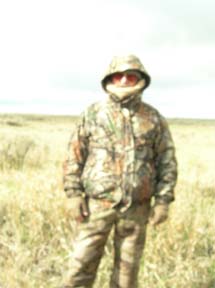
This is my setup this day. Warm without a down jacket and faily well camoflaged.
I know my landmarks and end up right behind the same serviceberry. The larger deer that was bedded down low under a serviceberry is now up feeding near the ridge and the Butt Brothers are 50 yards to the left, at about the same level. I may be wrong, but it seems that the bucks mostly feed on the plateau at night and spend the day down in a ravine. The largest bucks bed down the earliest and get up the latest. All three of my previous bucks have been bedded down when I saw them, even at first light. These guys conformed to this general rule. Miscellaneous does and fawns, nothing beyond the Stone House or on the Promentory, so after it starts to get dark, with nothing new, I back out and go over to the Waterfall lookout near the fence, where I was in the morning. Nothing at all. There is good sage beyond the Waterfall, but the canyon has steep sides with a lot of exposed rock and not much growing. I think that there is a relatively barren area between the Waterfall with its uplands, and the lands farther east.
I walk back to the SUV and head to camp. Road is bit drier but caution is needed. No fog, so I can drive a bit faster. The pogonip has all disappeared. I park at the gate, radio Bill. He and Craig think it has dried up enough for me to drive in, so I do. Mushy but OK.
We eat in the Cook Tent. It is really cold with the sun down. The tent is hot at chest level or higher, and we take off come of our overgear. However, the floor level is just as cold as outside, near or below freezing, so my feet do not thaw out. There is a real stratification of the heat. Not fun.
I am a bit bushed by the hiking and the wind, which is oppressive. I nod off after dinner, head to bed early. The plan is, if the weather holds, to drive in to the north rim of Waterfall Canyon, where I have gotten my last two bucks. Some hope that I will see something. Crawl into my sleeping bag with only two wool hats and no long johns. "Warm" for Wyoming.