
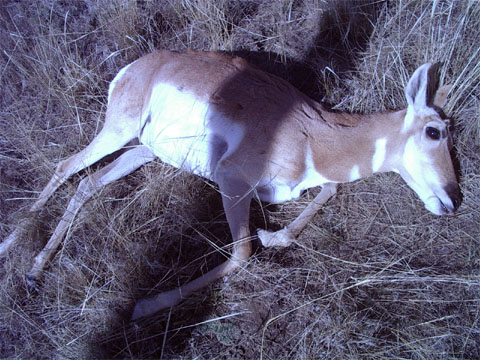
Don't nobody pooh-pooh doe tags.
Antelope are not deer. Nothing you know about deer applies to goat hunting- it's a whole new ball game. They're a herd animal- bucks usually run with the does, and does are usually with the bucks; especially around this time of the year, just after the rut. (Although I did see a first for me: a group of more than a dozen, all bucks.) And it's the does who are more skittish, more likely to run now and ask questions later. The bucks are the curious ones, especially if they have any notion that you're something that might want to horn in on the harem. The easy thing about does is that there are more of them and it's easier to find a 'shooter'. (Spending an entire hunt trying to nail down one certain trophy buck is another game altogether. But that's a topic better handled by Craig.)
That said, antelope are not particularly intelligent; nor do they have long memories. For the most part, if they remove themselves by a few hundred yards, then they consider the problem solved, done, and forgotten.
They're out there in the open, depending on flight, able to see the hunter if the hunter can see them- and it's likely that they do see him. Most hunting involves stalking after seen animals; so most hunting involves stalking antelope that are aware, to some degree, of the hunter's presence. If one is able to circle around, out of sight via a blocking ridge, life is better. But often one must approach from the direction of the initial sighting, at a disadvantage. And the truck is usually sitting in view, a reminder to the 'lopes that danger is a possibility.
It's a mistake to think that one can only shoot an antelope at long range. Sometimes it seems like they're always too darn far out there; and beginners are much too apt to badly chase 'lopers, with car or on foot, and never get close. But experience, brains, patience, and luck can put quarry nearly in your lap. My average this trip, and darn good considering the openness of the terrain, was <200 yards. I often got much closer, but rarely to a group with a shooter.
I did very well this time in sensing the moods of my stalkees, guessing correctly when I could keep closing in and when more would be too much. Which includes, yes, some unsuccessful sneaks that I knew were hopeless; but they had to be tried, nonetheless.
I got some good stalks in, lost a few gambits, and also simply filled some tags:
Doe Tag #2, 10/15-- As I drove to the Nat'l Grassland plots I saw a group of twenty or so on the hillside right by the highway of plot #1. I turned into the entrance right after another truck did and pulled up next to him. The fella glassed them and decided that none met his standards. I wasn't going to be as fussy, here on the tiny bit of public land available to me, but didn't want to whack one as close to the hwy as they were, and he offered to drive over there and nudge them in for me. I declined, he left, I sat in the Bronco and watched; one of the bucks had good mass but straight hooks, and Barkis was willin'. At first it seemed that they wanted to squirt the fence and cross the highway but after awhile they meandered inward, and soon bedded- up on a low rise, watching me from some 400 yards away.
I got out of the car, got my kit together, and walked at right angles from them 30 yards to a shallow ditch. Then I crouched and walked that ditch back past the car and to a groove in the slope that led up to the pronghorns. Some of that next leg could be done crouched, although I could always see part of the herd, but most of it was a belly slink: push the daypack forward with the left hand, push the rifle forward with the right, and slither up one push; push the daypack forward with the left hand, ... I followed an old, and long unused, cow path up the bottom of that sway in the slope, giving me an additional two inches of cover, and also it had fewer sages in it, until I was becoming more exposed by the slope and by a thinning of bushes.
So at 240 yards I prepared for a shot at the buck. I plopped my daypack on a sage (all this sage was short and stubby, not like the luxurious stuff that houses our Nevada bunnies), partly hoping to alarm them and get them to rise. No dice. And there was a twin sage right in front of mine whose branches were some in my way, so I climbed on mine and broke off what I could ahead. Then I settled in for a little wait. Occasionally one would stand and nibble a bit, but soon would lie down again. I was tired and uncomfortable, they'd only recently bedded- I didn't want to pay for long-term parking. So when a doe stood up behind my bedded buck I dumped her.
My hope was that the group would stand and gawk, wondering what just happened. But no- these guys had been to this school before, and straightaway trotted off. They stopped at 300 yards to stare back at the dead doe but my only shot was from the sit and too iffy for me, so I passed. When they went over the top I hustled up after them but found them far away in the bottom of the next valley and not intending to return anytime soon. Even so, I went over to the next peak, near the highway, and watched and waited, hoping against hope. But they continued moving away towards the coal works, so I accepted the loss and collected the doe.
It started as a buck hunt, and the stalk was as good either way. ("Good" somehow means 'difficult, strenuous, and stickery'.)
Doe Tag #3, 10/16-- Nothing was showing at plots #1 & 2 so I went to look at #3 for my first time. I found a Portogee gate from the highway and turned in. (Nice- the loop holding the post was part of an auto-leverage system, easy to open and close.) I parked right there by the fence -couldn't have gone anywhere anyway: no road- and saw some antelope straight out from me.
This plot was larger than the other two, say three square miles of usable antelope land, and flatter and barer. Some of it was pure grass, some was scattered, low sage, and there was also a patch of scattered bushes of some other type, a bit taller than the sage. Luckily for me for this stalk, which would otherwise have been impossible, there was a dry wash I could use. It wasn't anywhere near the animals but it could take me away from their consciousness- for they were quite aware of my presence. So I left the antelope to stare at my white Bronco while I walked along the fence back down the highway a couple of hundred yards to the wash. I dropped into it, a perfect five feet deep, and followed its winding course into the pasture until it petered out, fortunately at about the same distance from the fence as the pronghorns.
I climbed up the bank and snuck forward until I found the herd, unaware of me but drifting away (straight away from me now, parallel to the far-off highway). I followed, hunched and sneaky, trying to remain behind a bush when I could, but my cover was pretty sad. This was one of those times when I just sensed what I could get away with. Finally they bedded, on the top and far side of a little roll in the prairie. I could see four heads- none of them facing my way, fortunately. I kept going, hunched and on my knees, until I called a halt 130 yards away. I lay prone, rifle on pack, for an hour, ready. I considered mewing with my call, decided to not bring attention to myself; to just wait.
My position was good, if I got the right breaks. As I wrote, they were on a little ripple. If they simply stood, I would have a good shot at some of them between bushes; but if they started away, down the far side of that ripple, or had a bush in the way, my wait would be for nought. I got a 'tweener. They didn't do much standing around after they rose, but meandered; I could have shot some of them, for very short periods, but not all. Some were just heads, some stayed behind cover, and there were quite a few that I never saw. And none of the good targets was a buck worth shooting.
They started away and to the right, and I tried to follow along but I got busted. That started them at a quicker pace, and one they wouldn't relax for some time. So that group was history for me. But now that I was well out in the parcel I could see other groups of antelope ahead of me and at the base of the hills to my left, so I hunched forward for another try at the ones scattered 500 yards ahead. But there were two off to my right that spooked, and they alarmed and pushed my quarry toward the hill.
They seem to forget quickly; I was gaining ground. The 'hill' is an abrupt bit of badland, an old eroded mesa, some six miles long, parallel to the highway. All the pronghorns were now fairly tight to its base, strung out in an interrupted line. I was creeping, hunched as painfully usual, towards them but, more immediately, I was approaching a lone doe. I don't know why she was still out there. She hadn't been with any herd; she was just eating alone, and entirely unaware of me. But that last wouldn't last for long. I'd been sneaking in straight at her for 200 yards, concentrating on her rather than the ones I was after: resting (hopefully not on a dang cactus) when she'd lift her head, crouching forward when I could. And she was the most contemplative antelope I've ever seen! She'd lift her head after clipping a tidbit of browse and stare out across the prairie for the longest darn time, freezing me in place.
But at 120 yards distance I had to push 'pause' on the action. I'd been in plain sight the whole time; my luck couldn't hold out much longer. I was only 400 yards from a herd that held a nice-looking buck, but 120 yards from their sentinel, the doe -and stuck. So I dumped her.
As hoped, the other pronghorns gave the shot little thought. I marked my position on the GPS, and took a bearing on the doe's direction from there, and continued with my stalk. I found a little erosion ditch that allowed my back a few inches less of hunching, and took that at an angle for awhile before it gave out. But then I was into an area that was mainly grass; as was most of what still lay between me and the antelope, which were still drifting away. Soon I was too much for them to ignore; they became more purposeful, and I had to give up the losing cause.
But I got another doe, again while buck hunting, with plenty of good sneaking involved.
On the other hand:
Buck tag #2, 10/17-- I saw nothing as I drove past Plots #1 & 2, went back to the Portogee on #3. ...Yadda-yadda, some six hours later, late in the afternoon, I drove back down the highway to see what I could find on #1 or 2. As I drove past the east entrance to #2, which has a gravel road leading to a few buildings called the "Work Center" and whose gate is locked (for administrative personnel only), I saw a few near that road not far from the highway. I pulled in and stopped in front of the gate, gave them a perusal. This was Saturday. I'd already held camp three days beyond Durham's original expectations, the trip was two weeks old, rain was expected Monday and I hate taking down a wet camp, the day had been long and frustrating, it seemed that the public land was being visited less by peripatetic antelope and I didn't want to push my luck --the buck in the group was good enough for me.
The pronghorns were very aware of me, a newly stopped vehicle only 120 yards away, but they seemed unconcerned. But when I dismounted they began walking (on a well-used trail, as I later learned) from my left to my right. The prospect of losing them while I diddled in my mind settled it. I jumped out, grabbed my rifle, climbed through the fence, and went prone against a post of the Grassland sign.
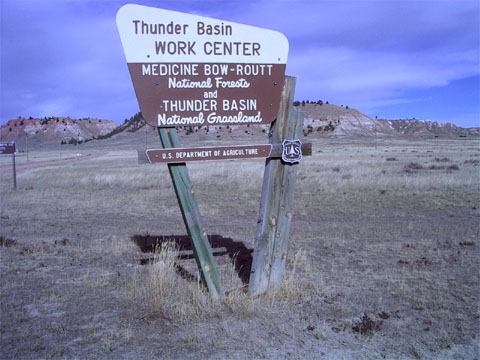
They were off to the right, now, putting the buildings well out of the line of fire, and the buck was about 175 yards away. I fired. He didn't fall but he stopped, almost straight away, so I shot again. Confident that I had him, I turned my attention to the does, hoping for a double. The lead doe, typical of the gender, was unconcerned about the fate of her annoying male follower and was now pretty far away and at an extreme angle. I tried to get a shot at one of the two following does, equally blase them, and stopped her for an instant with my call; but her companion got in the line of fire, and I was unable to cause another halt and lost my chance. I then looked for the buck but couldn't see him- a good thing.
I quicked back to the car, moved it so that it wouldn't be blocking the gate, snatched up my daypack, stuffed two more rounds in my rifle, and hustled back through the fence to make a try at catching up with the does. Naturally, I failed. So I took the one in the hand, left the three to their bushes. I found that the buck wasn't quite finished, so I had to put one at the base of his neck.
Not exactly a difficult and suspense-filled stalk. Fun, though.
Doe tag #4, 10/18-- After playing awhile on Plot #3, I drove back to #2. Nothing was in sight at the Work Center gate so I continued to the public road further west. The road goes in a ways and then curves east. Not far along there I saw a few 'lopes eating between me and the highway, more to the east. I was getting my gear ready for an approach when they began to drift away towards the Work Center. So I hopped back in the Bronco and drove back to the gate, ahead of them but not by much. I only had time to gather my binocs, rifle, and rangefinder, slip through the fence, and get prone at the base of the sign again. As they walked along the same trail as yesterday's prey I tried the call trick again, and again failed, so I panned on a doe, trying to stay hard on her shoulder, and fired. She dropped, but somewhat slowly. I hadn't needed my rangefinder, but the distance later read 178. (The buck, a male showing typical concern for his fellow, stood and stared back at her for some time. Just saying.)
Another fill-a-tag hunt.
Looking back from the doe:
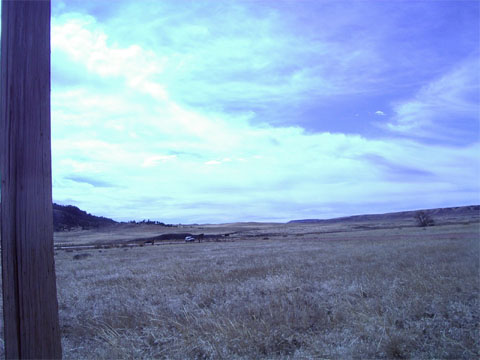
The Bronco is the white dot left of center. (The pic does better at full size. I hope you can easily look pop it up.)
And for a fairly typical pronghorn hunt:
Doe tag #1, 10/14-- I'd spent most of the day hiking up to and around on top of the hills at the head of the valley of Plot #1. Coming back I saw four antelope way down, a half-mile behind the car. As I sat on a point to call for Wile E., a small buck broke off from the foursome and began walking my way. He had a long way to go and it took him some time, alternately walking, trotting, eating, standing. Why this herd animal would leave the only others of his kind, and leave the more open and flat areas to penetrate into the narrowing dead-end of a horseshoe-shaped ring of steep hills, I haven't a clue. Guys can be like that, sometimes.
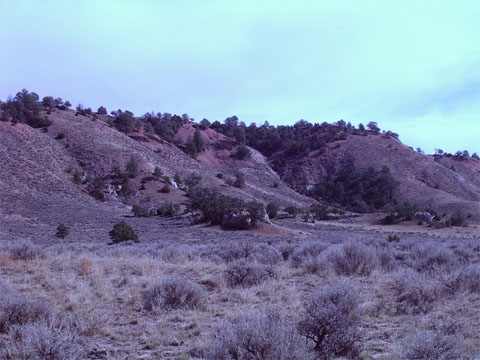
I carried only a doe tag so let him go by me, and behind a knee of the hills, but noted that the other three remained bedded. I continued the half-mile to my car, and drove toward the highway. The antelope stayed on their little rise close to the base of the hill. I stopped at the road's nearest approach, at which time they stood in indignation at my intrusion, and inspected them. Looked like two bucks with a doe. Hmm- I had a doe tag in my pocket and nothing bloody to show for the day. So I drove on until the road wound out of their sight.
I had two simple ways to attempt the stalk: I could walk back to where the road crossed the dry wash that came from the base of the rise they were on, and try to use its banks, and the junipers that grew sparsely there, to come in under them, or I could stay on the back side of the long, low ridge they were on, and pop over the top at them. I chose the latter (among other reasons, I wouldn't have to crouch-walk).
As I approached a little grovelet of pines at the peak, which seemed like a good screen for me, I saw the pronghorns ahead, going to my right behind a hillock. I guess that screen helped them more than it helped me. But the antelope were avoiding the steeper, more clothed, hillsides, and were curling around me. I plopped down in the dirt, rifle on daypack, and tried to follow them as they appeared and disappeared on different knobs and around slopes. I could tell which was the doe by her much shorter horns. I stopped her once with my predator call but a buck stepped between us.
The good thing about their curl course was that they came nearer instead of fading away. Finally I was able to stop her again while she was in the clear, and I shot just as she started again. She staggered and stood, but soon fell over. 146 yards. She was not quite dead when I got up to her, so I finished the job with my .45.
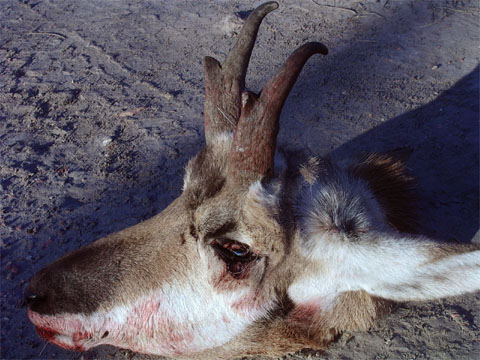
That was somewhat typical- seeing antelope, driving out of sight, and then planning and executing a stalk.
And there are the stalk stories of five of my six (Buck tag #1, the Durham hunt, will come in time). I left out miscellaneous particulars to focus on the hunts; they'll come later, in different contexts.