Montana Hunt 2011
Tuesday, Oct 25

Page Seven
First posted November 27, 2011 Last edited November 28, 2011
David's Fourth Day: 6 by 6 Canyon
Tuesday and Craig changed the entire rest of the hunt.
I was a bit tired from the dawn-to-dusk day on Sunday and the hunting in the snow on Monday, so Tuesday morning I slept in. The fact that the thermometer lost faith in the sun and dropped to Zero overnight might also have had something to do with it, too.
Craig and Ted went out early, as I remember, and when they returned, Craig could not believe that Bill, Eric, and I got up around 11 am. I mean, we could have slept later if we were really lazy, I suppose...
Craig had filled his elk tag (or at least half of it...ahem), so he was hankering to see some deer, which had been mighty scarce (total: 0) to date. He wanted some company while he drove far south of our hunt area to see if it might be better deer habitat. I was feeling guilty about not being out hunting, so I volunteered to join him, and off we went.
We toiled up the closed access road, bouncing. It was horribly eroded, so badly that one bounce had bent part of Bill's trailer hitch luggage rack when he first came in. We jolted up the road from the valley on Craig's truck's stiff springs, as if he was employed in his father's profession and was trying to jerk out all of my teeth. A ride in Craig's truck is never pleasant, and when the road is as bad as this one, you just pray that your health insurance covers dental care.
We headed east on the Highland Highway for a mile, then turned south. We passed below Red Mountain, towering high and snow-covered above us on the left,
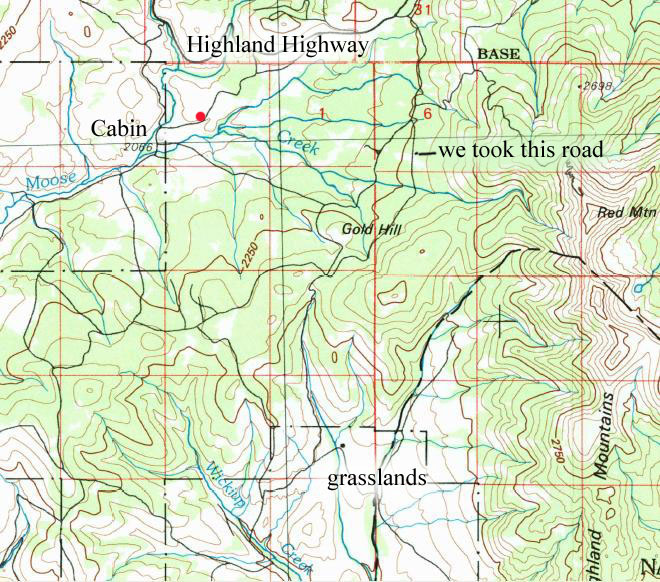
and behind Gold Hill, below us on the right. (More on this feature later in the week, or if Craig and Ted tell their tales). We crossed a mountain ridge and started to descend. The entire country underwent a dramatic change.
As soon as we passed the mountain's crest, the rocks changed, the soil changed, and with them so did all the plants. While it may be obvious to you, I only recently learned* that the soil normally is determined by the underlying rock. The chemical composition of the rock, breaking down over millennia, dictates the chemical characteristics of the soil, which in turn determines the plants that occur there. Not all plants can grow in all soils, with pH, water retention, and nutrient profiles determining not only which plants can grow (a simplistic view) but which plants can prosper and out-compete the others. The plant profile is determined by the edaphic profile, and when the rock underlying the soil changes from one area to another, the plant and animal communities also change.
Just over the mountaintop, the trees were no longer lodgepoles, but I did not know what they were. The open hillsides changed from sage to grass. The far side of the ridge was impressively steep (with one of the craziest switchbacks I have seen in a public road), revealing a wide open basin yielding to an open grass plain as far as the eye could see, with cows, fences, and, close in to us, cowboys on horses. The change from the Continental Divide and forest-covered mountains we were hunting to grassy plains just a bit further south was uncanny. We explored the grasslands a bit, but Craig did not appear impressed with its deer potential. His assessment might have been influenced by a camp full of hunters that we passed. We went back to our side of the mountain.
Craig suggested that rather than just going back to camp that we try to walk out one of the closed roads that we had passed on our way south. Although he might see a deer, I got the feeling that he was actually doing it more to help me hunt some new territory and maybe get an elk. I agreed. He suggested two possibilities, and I fatefully suggested a road that went due south from the point where I normally parked the Bronco on my way north to the meadows. The hunter I had met the first day had said that this area held a lot of elk, and that we should not be put off by its fairly humble appearances. The road only went a short ways into the middle of the Moose River valley. My map showed that it did not cross Moose River, the same Moose River that flowed past our cabin, only about a mile downriver.
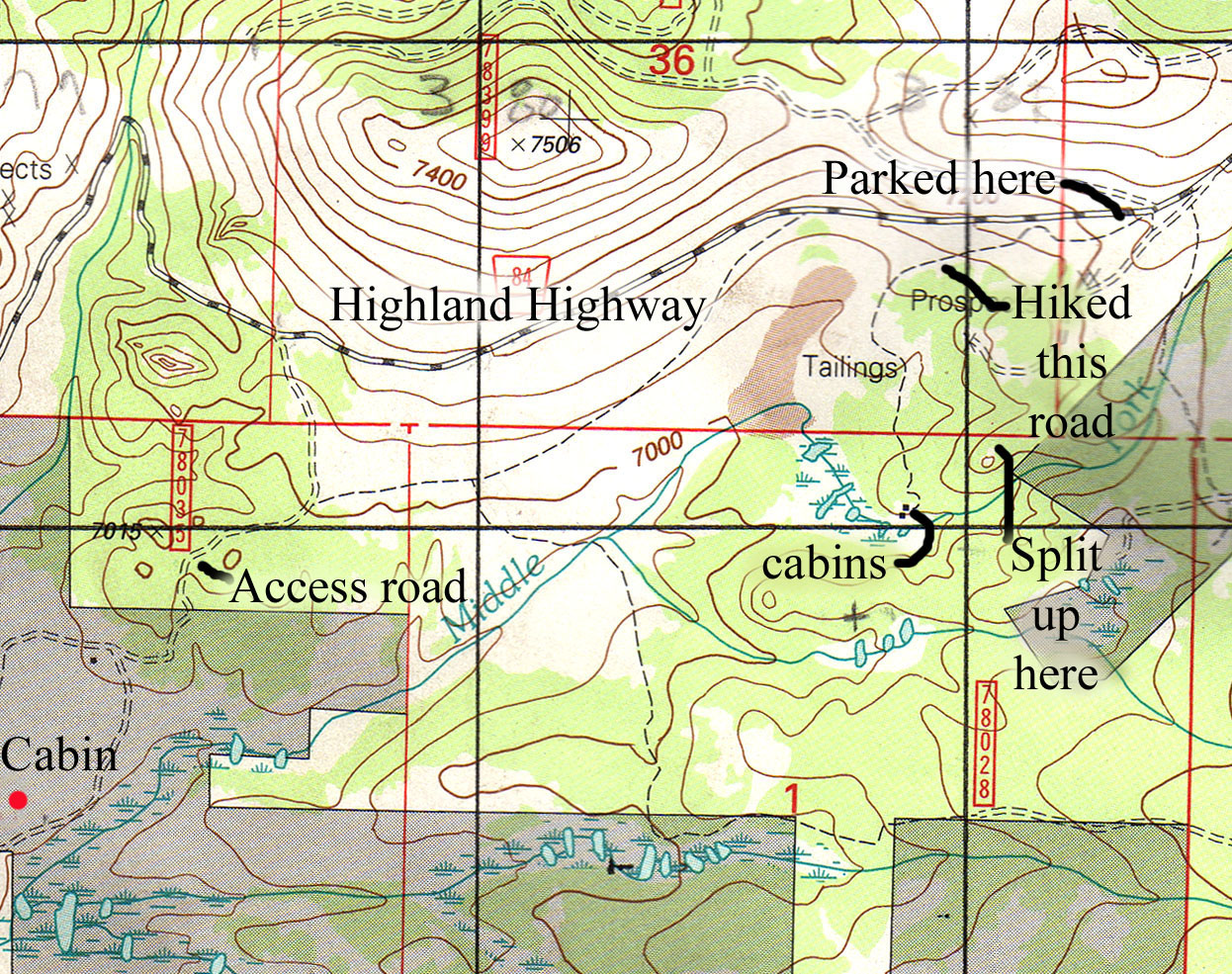
Most of us did not hunt the Moose River valley, preferring to go out of the valley and into the hills and forests surrounding it. This was somewhat like not hunting Grasshopper Flat or North Flat at the Ranch: it was too close to the cabin we were staying in, it was too close to the road, and there were too many road hunters roaring up and down all night and day. Honestly, it looked a bit too flat to provide much cover for any self-respecting bull of any size, and there were private land and homesteads down there.
But as we got out of the truck and looked it over, it was evident that the land was more complicated and had a lot more cover than the valley we were used to, nearer to the cabin. We geared up and started walking. As we walked, we made arrangements as to who would shoot first: Craig asked for dibs on any bucks in exchange for my getting the shot at any bulls. This actually seemed self-evident to me, since he had filled his elk tag but had an open one for a deer, and the only reason we were in the field at all was that he had dragged my sorry butt out of bed and was driving all over in his truck. I readily agreed.
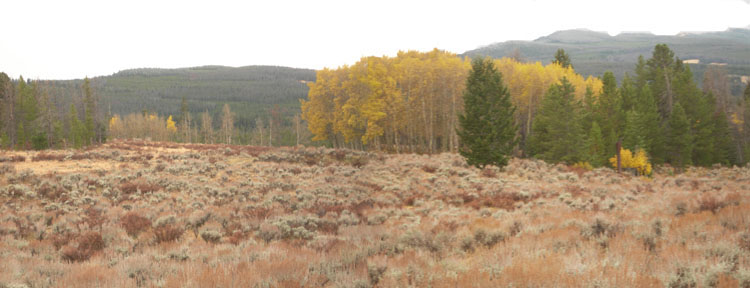
This was the view as Craig and I hiked out from the truck
The road skirted the aspens on their left and then headed downhill, behind the aspens
We walked about a quarter of a mile, descending on a road that disappeared into an area that had been recently logged, probably this past season. We skirted the first aspen grove that I had seen (they are in the center of the above photo). It was a pure stand of tall, mature aspen, forty feet in height. The leaves had changed to gold and half of them were on the ground, giving off that strong and unique aspen-leaves-rotting-on-the-ground smell. An ester or keytone fragrance, it seemed. Sharp and sweet at the same time.
It seemed silly that we were walking side-by-side, and I thought that we could cover this territory better if we slightly split up. I suggested that Craig drift about 50 yards to the left and I would ease slightly right, then meet up at the bottom of the hill, where the cover changed from open to a mature lodgepole forest, where the logging had stopped. He agreed and we parted. We could still easily see each other, and both of us would see any game that flushed out into the ravine we were descending. I made some mental notes about muzzle safety and to be aware that Craig was in my line of fire if I turned to my left.
Craig moved along, but shortly was not moving off as wide as I had intended, with the result that he got far ahead as well as directly in front of me. He might have had a shot at anything that moved out, but I was too far behind to have safely taken a shot. He moved up beyond our meeting place, peering around some rocks (photo below) into the next area, which was obviously had great potential. I suspect that his hunting instincts took over and he forgot that we were trying to do this as a team. I was learning what it meant to hunt with Craig.
When he finally pulled up and I caught up with him, I suggested that we try a slightly different tact. We were at the edge of a small ravine, with a creek in the bottom and dense forest rising rapidly on both sides, with a very impressive rock formation along the close side. I knew Craig would move out rather quicker than I would, so I suggested that he wait a moment, then move into the valley, hunting down the creek. I would move back to the logging road, hunt along it parallel to the creek, and take up a position lower down the creek. I pointed out where I would be and would meet him: the trail went down then hooked left, intersecting the creek. The map showed two cabins there at the edge of the creek. I would meet him at the cabins. I wanted to be in a position to catch any elk he pushed out ahead. I don't think Craig was listening, as he already was planning his drop into the creek bed. The area really seemed to have a lot of potential to both of us, and I think both of us were excited.
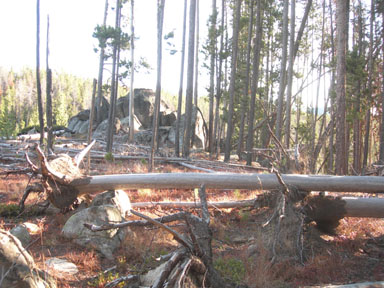
These were the rocks at the edge of the canyon where we split up
I moved out quickly. The logging road went down a slight gradient but it was easy walking. The forest was very thick and mature, with some rather large trees: I could see why there had been logging just uphill. I saw elk sign as I went, with some slightly clear areas in the trees with grass. This was a lot better elk country than I had first thought, and a lot better than the meadow country I had been hunting. I tried to hunt as I went, but my prime goal was to get to the creek bottom before Craig drove any game out. The forest may be so thick that you can't see the elk, but a drive might work. That was how Craig had gotten his on opening day, with another hunter driving an elk out before him. I hoped to duplicate it.
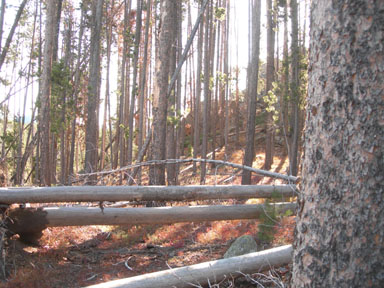
This is the view as I walked down the logging road
The rocks from the above picture can be seen through the trees
I used my GPS on the fly to be sure that the road I was on was the same one on the map and to be sure I was heading to the correct meeting spot. The road diverged, which was not on my map, but it was clear that I needed to take the left fork, which went over a rise of 25 feet. As I climbed up, I could see the creek bottom. The road veered a bit upstream, taking me closer to Craig, and then opened out into the bottomland. It looked like marvelous elk country.
The creek bottom was about 50 to 75 yards wide, mostly gravel. There were willows and grasses along the watercourse in the center, mixed in with aspen, alder or sycamore, I am not sure right now, spread out sparsely across the bottom. The forest was quite dense on both sides, giving a feeling that this was a small, secret hideyhole. I loved how it looked. I picked a place well back from the creek bottom, but still with a clear view all the way across and about 100 yards up and down. I should be able to see any fleeing elk, and hopefully have enough time for a shot. The wind was partly in my face and partly blowing in from my right, so my scent should not be a problem. I set up next to a tree, again checked that I had a good field of fire, and waited.
And waited. And waited. No sign of Craig. I became worried that I had missed him, and that possibly I was out of place. I rechecked my map and GPS, I was at the meeting place. Maybe he had a problem. I waited a bit more, becoming increasingly worried. Setting up meetings can be a pain, if they go awry. What if I went back to the car and Craig showed up here? I worried a bit more, and then decided to call him on the walkie-talkie. It would interrupt his hunt and possibly scare some game he might be drawing a bead on, but he was way overtime. I knew how the radio drove Bill crazy, so with some trepidation, I got out my ears, turned it on, and called Craig.
"David, why weren't your ears on? I have been trying to get you forever. There is a 6 by 6 bull in the creek bed right up at the top. Don't go after him, just head straight downriver and get out of there."
"Why not try to get him?"
"No, listen to me. Head straight downriver, get out of there, and we can go for him tomorrow. For now, just get out of there and don't scare him. I am in the truck, I will go down the Highland Highway and pick you up near the saddle."
Wow, things were getting hot. I did not want leave, that did not seem to be the right thing to do. But obviously Craig knew more than I did about the situation, so I had better follow his directions. Our conversation had been pretty brief, I would learn more when we met up. I looked around. To go into the creek bed and go downriver would expose myself to the bull. Craig did not know the layout here as I did. I decided to moved directly away from the creek, partly retracing my steps. I headed back along the road I had come in on. When the road turned to go up the hill, I continued north and a bit west, heading cross country, through a slightly younger lodgepole forest, across a clearing and into an aspen forest, and then into the open. This was a sagebrush hillside that sloped uphill to the road, only about 400 yards away. I could see the white truck near the saddle, and headed over.
Craig was his usual excitable self. He wanted to know why I did not have my ears on and why I took so long and that he had seen the bull right after we split and it was a bad idea to split up and he had been against it from the start and the bull saw him but he just froze and where was I all this time and the bull was a 6 by 6 and we would have to get him tomorrow and that we never should have split up and he just has a knack for finding game and he was against splitting up and if I was going to hunt with him we were not going to split up again. And I think there was more, all delivered in one breath and fired like a machine-gun. I asked why he didn't just back off and come find me, but he said he didn't know where I was and that the best thing was to come here tomorrow. We discussed it then and we have since discussed it many times since, with little further understanding of how this exactly went down. It will just have to remain a mystery, why we split up and why we did not get together again. But at least there was a 6 by 6 bull in the area!
* I learned this by reading Kruckeberg, A.R.: California Serpentines: Flora, Vegetation, Geology, Soils, and Management Problems, University of California Press,1984. Lest you think that this is a rare volume, mom already had a copy! It discusses the geology of the California Floristic Province with respect to the areas that have serpentine rock (our state rock) and very special plants called serpentine endemics. These are plants found only growing in serpentine soils. Serpentine rock has a very unusual and high concentration of magnesium (ultramafic). Soils over serpentine rock also have a high level of magnesium; this is where the word "edaphic" comes in. The magnesium ion, Mg++, displaces the calcium ion, Ca++, in plants, poisoning many but not all species. The plants that can tolerate the magnesium are called serpentine tolerant plants; plants that require a high level of magnesium are serpentine endemics: they only grow in serpentine soils. Part of the uniqueness and breadth of California plants (we have more than 5000, the largest number of endemic plants in the US; indeed, more than the combined total of the central and eastern United States and adjacent parts of Canada. ) is due to our serpentine soils and serpentine endemics.
Back to Wyoming Homepage Back to 2011 Homepage
Back to 2011 Page One: Introduction Back to 2011 Page Two: Opening Day
Back to 2011 Page Three: Craig's Elk Back to 2100 Page Four: Finding Craig's Elk
Back to 2011 Page Six: David's Meadows, Day 3