Oregon Hunt 2014
Page Five Sunday October 15
First posted October 21, 2014 Last edited October 27, 2014

The final day was raining intermittently, after a hard night of raining. Bill initially wanted to stay in, he was bushed from his long walk the previous day. Although Ted was right that the mountain would trash me (I never got to the Pacific Crest Trail), I did not want to waste the last day of the season in camp. My plan was to go down 1280 to the Abbot Creek Campground. It was right beside the road, so the road hunters have been going by there all the time, but I thought that it still held promise. Bill and I has passed the area on our way to look at the Metolius and the lava beds, and we agreed that the feed looked good in the marsh there. I had been studying the plants, and I felt that the variety of growth there in the marsh should be attractive to deer. I also thought that the deer would be hidden from the road hunters, and might not mind coming out as it got dark. If I got anything this night, it would sure aggravate Craig and Ted, who struggled up the mountain for hours to get to the back country. Here I was planning on sitting right beside the road!
Bill finally decided to go out. He conceived a plan to have me drop him off up Road 1230, past the turnoff to 900, and he would walk down the ridge north and northeast of camp, following an old logging road (pink dots in map below). He had walked most of this area before and knew it was open enough to allow hunting. He would come out on the road 1280.
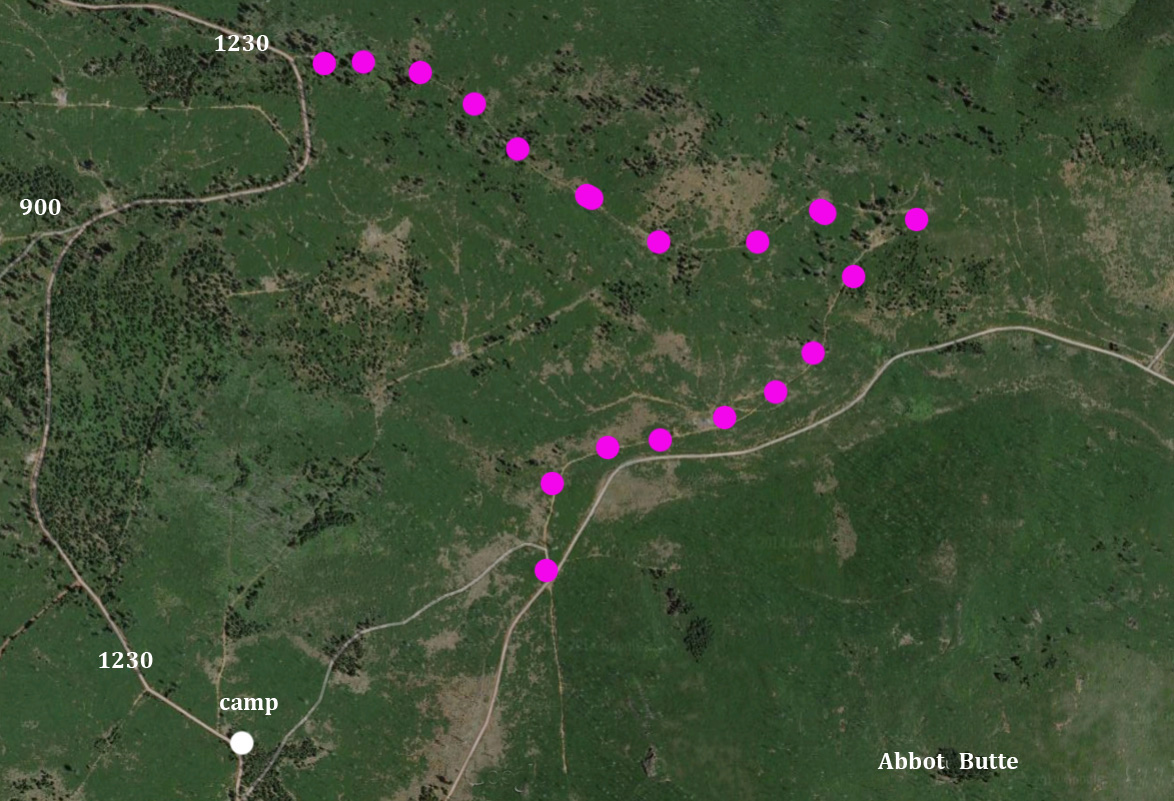
Bill would come out from his walk on the road I took back to camp, so I was going to pick Bill up on my way back after the evening’s hunt.
It was quite strange to drive the Bronco, as I am not at all used to such a stiff suspension, the different engine and gearing, etc. I drove Bill to the drop-off point and then headed out 1280 to Abbot Creek Campground, about 20-30 min away.
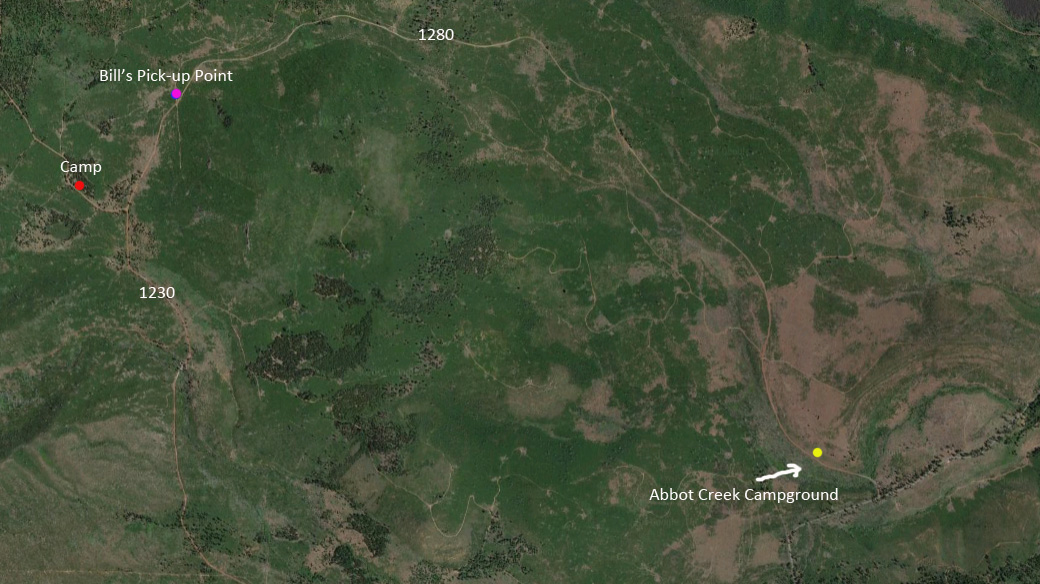
I drove past the “campground” (there is no campground, only a marsh; I presume that there was one at one time but it got destroyed in the 2003 fire) and decided where I wanted to sit as I passed it. I drove a bit further, turned around, and parked the Bronco behind an small elderberry bush, about 300 yards away, so as to not disturb the hunt area. I scanned the meadow as I walked along to my chosen area, but saw nothing. I dropped off the road just past a large elderberry bush. The embankment was quite steep. I was about 8 feet below the road but only 4 feet off of it. There was a nice horizontal log at about the proper gun-rest height, so I plopped down on a rock, rested my gun on the log, trimmed off a snowbrush bush that limited my view to the right, and started to scan the area. I could see into the marsh quite well, where I expected to see game. The far side was largely blocked by the standing dead pines, but the area had only snowbrush and a limited amount of grass. The deer might pass through here on their way to feed, but there was not much here to hold them.
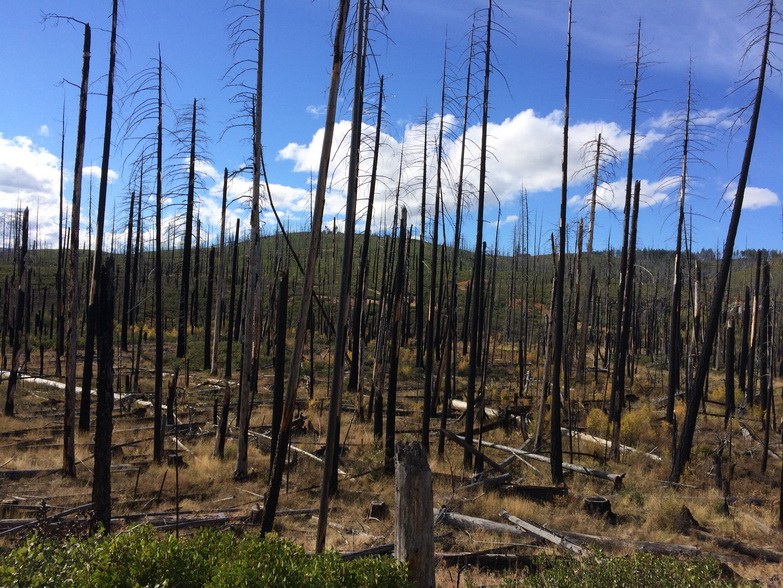
I immediately picked up two does on the far side of the marsh, beyond the good feed, and slightly uphill, in the snowbrush. They seemed to be disturbed by my arrival and were moving around. I thought that they were leaving. I shifted my position to better prop my elbows and get a steadier view. I lost them behind some burned trees, then they appeared in a narrow opening. And one "doe" had a fork! I was excited, but worried.
The opening between the burned trees was about two deer-lengths long, so if he moved, I would lose him. He was small, but the group had not yet seen anything to shoot, and it was the last night of the season. I decided to try to take him.
Here was his location:
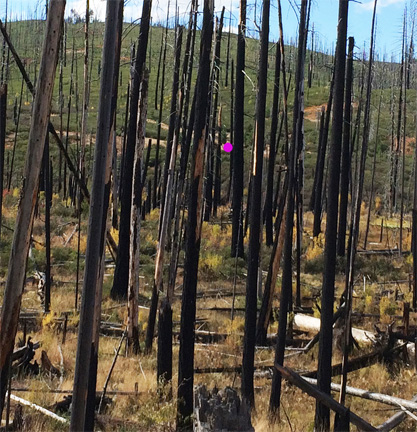
I brought up my gun, but could not find him in the scope. I switched quickly back to binocs, found him in a narrow opening (I am not sure if he moved or if I just could not find the narrow slot between trees where he was), and found him in my sights. The positions of the two deer had shifted. I could no longer see the other deer, so I think they were moving, possibly fleeing.
I made sure this one had the forks. He was broadside, there was no tree or branch in the way, the time was now or might be never. I placed the crosshairs just behind the front shoulder, about half-way up the body from belly to back, put some pressure on the trigger, and was almost surprised when the gun fired.
He completely disappeared.
The doe he was with appeared in about 60 seconds, trotting into the meadow, toward me, then turned aside and disappeared into the brush. I scanned every opening, near and far, but I did not see him again. My heart was going fast. Had I missed? The pressure was on.
I lasered the distance, 336 yards, time was 5:45 pm, and wrote the data on my topo. I marked where I shot from, on a dead but white tree, with some charcoal, so I could locate the firing position from the other side of the marsh. I tried to identify and memorize landmarks that I might recognize when I got to the far side, but I could not see much through the trees, and the area did not have good landmarks. I went across the marsh, keeping the opening in view as best as I could, but the blowdowns and scrub forced me out of line when I was half-way across the marsh. I tried not to rush it and fall or hurt myself, but my heart was racing. I forced my way through a wall of about 30 feet of the scrub and to the clearing you can see in the photos. It looked like the spot where I had shot, so I put some surveyor's tape on a branch and took a GPS reading. There were many heavily-traveled deer paths, intersecting and crossing. This place has seen a lot of traffic.
But absolutely no sign of blood. The rain began. I searched for 45 minutes. I went along all the many intersecting paths. No trace. No blood at the site of the shot, no blood on any of the trails, no blood on any of the bracken ferns. I expected him to try to escape via one of the paths, probably in the direction he was facing when I shot. So I went down as many as I could, for about 100 yards, then retraced my steps and tried another path. I did not want to give up looking, but as darkness set in, I calculated how much time I would need to cross the marsh and get back to the road, and left at the latest I could.
A complete miss? I returned to camp with a heavy heart, picking up Bill on the way. He had seen about 12 deer, but no antlers, so he was disappointed.
Dinner and the evening was very somber for me. Did I blow the only shot taken on the entire trip? We all hate wounding but not retrieving the animal. The distance, 336 yards, was a bit farther than I had thought, and there was no time for a rangefinder reading before I shot, as the buck was moving, possibly responding to my hiking the road, possibly to my scrambling down the steep hillside. If I had known it was 336 yards, I would have held a bit higher. But my gun is sighted in a bit high, 4 ½ inches at 100, so that might not be too bad. The shot was taken rather quickly. I am used to having all the time in the world, to be sure I am in a good position and steady, etc. I am not experienced in quick shots. The rest I used was perfect, both for steadiness and for height, so the mechanics of my shot should be OK. But without a buck on the ground, my heart was down. Going to sleep, this was the only thing on my mind: did I blow it? Was I the goat for missing the only shot taken the entire season?
……………………………………………
The next morning we got up leisurely but with anticipation. There had been a moderate amount of rain overnight, but it was only lightly cloudy now. We got our packing-out packs ready, with deer bags and Wyoming saw. We left our rifles in camp. The season was over and we did not want to be found in the field with rifles after the season closed. Bill brought his sidearm. The day cleared more and more, and by the time we drove to the Abbot Creek Campground and parked, it was clear and warming.
I showed Bill where I took the shot from and where the deer was standing. Bill stayed at the spot where I shot from, I crossed over. Via walkie-talkie, he directed me to the correct opening. It was not where I looked the night before. In the image below, I shot from the small pink spot at the edge of the road. I had searched the previous night at the yellow dot (I found my surveyor’s tape), but the deer was actually standing about 100 feet south, at the large pink dot. Bill started to cross over the marsh as I began searching along all the paths, first heading toward the creek, since that was the direction he was headed when I shot.
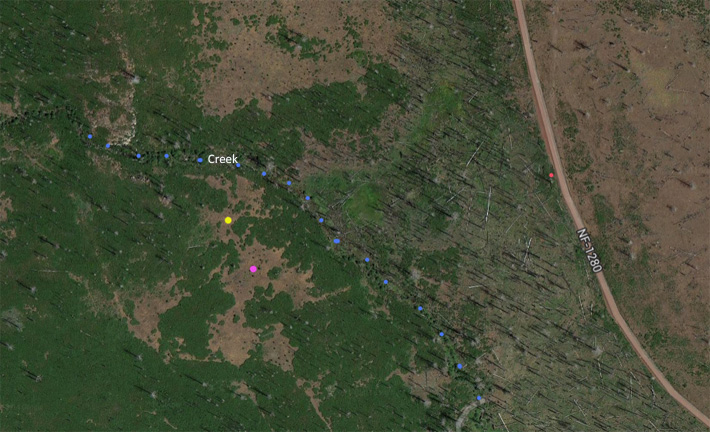
I looked in every nook and cranny for the buck. It is amazing how many grey rocks there were in the brush, looking just like a downed deer. I searched all the way to the creek along several paths. Nothing. It was going to be nearly impossible to find the buck, as there were many many paths and they all seemed to end in thick snowbrush. I had no idea which direction he had run, so we needed to look in every direction. Miles of paths. I did not try burrowing into the brush, expecting that he would have travelled along a path. If we added brush to the paths, the possibilities were daunting. We would need hours to cover it, and my plane left that afternoon. We would need to leave here in just an hour or two. I was not very optimistic. Missed? Hit and lost? ????
I did not even know Bill had crossed the marsh when I heard him call out, “I found him!”
I was amazed. First, I did not know that Bill had had time to cross over, and second, he could not have had more than a few moments to look. I headed back to the clearing where the buck was when I shot, and Bill pointed to a thicket of snowbrush, about 75 feet away. I plunged into the thick brush, and about 20-30 feet in, there was the buck.
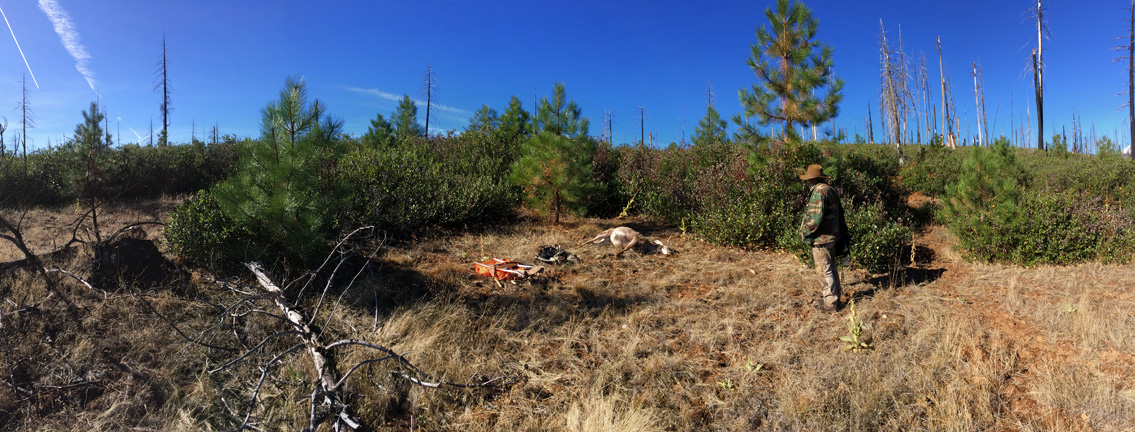
This shows the buck after Bill and I pulled him out of the brush. Just uphill of the buck, and to the right of the pine, you can see a dark area of the snowbrush. A deer path extends from where he was standing to the edge of the brush. We could tell that deer passed through the brush here, because the brush had just a slight suggestion of having been parted previously, but it was still a solid mass of snowbrush. Bill had found the buck about 20-30 feet into the brush.
I never would have looked there in a million years, yet Bill thought to search here first. Bill is amazing, and his reputation should be solidly enhanced by his instincts and ability to find the buck.
It made me remember the time that Steve Wyosnick shot a buck along the fenceline above South Flat. The whole bunch of us, except Bill, searched for hours. Bill came over and found it in moments. He just has incredible instincts about where a buck might run and how far.
Bill said that his thinking was that the buck, if hit or scared, would seek the safety of wherever he had come from. His best guess was from the brush uphill of the area, so that is where he looked. And bingo, he was right. It may not seem like much as you read this, but I think I could have looked for days and never found the buck that deep in the brush. Bill is amazing.
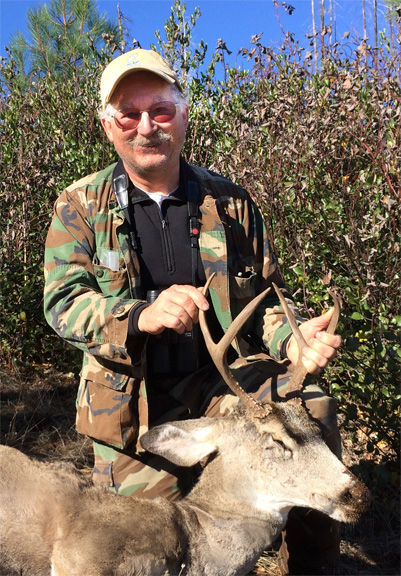
The buck scores 71 6/8, 110 inches short of the Book.
This buck is not big, but it was the biggest one seen and the only one taken. Bill teased me that the buck that it was so small, it “still had milk on its lips”. I am the first to admit it was small, but it is still the biggest one seen and the biggest one taken. Like Craig’s elk with only one antler: it might not be a great mount, it was still the only one taken on the trip. It might have milk on its lips, but it sure should be tender! (Reminds me when I was skeet shooting during residency. The chairman was a skeet buff. Every time I broke a bird, he would say, "That's a good eatin' bird!" Only later did I learn that what he meant was, I almost missed, there was hardly any shot in it!)
After dragging the buck into the open, we searched for wounds. The bullet is an e-tip, with a solid copper rear and a six-petal front. They tend not to break up much, so the exit wound was not large. The lack of bleeding externally hurts us when tracking bucks. The exit wound was obvious: just behind the far front leg, rather low in the chest, but small. We could not find the entry wound, despite searching around. We did not find it until we started skinning him. The entrance was just behind the front leg, hitting the leg but not the bone, and the entrance to the body indicated that the leg was slightly back. The bullet went in about 4” below the midline, from belly to back. It would have taken out the heart or great vessels and both lung apices (the top extent of the lung), which would explain why he ran only about 30-50 yards or so.
My great thanks to all the guys for including me in your draw and the trip. My great thanks to Bill for arranging everything for me (license, tag deadlines, etc), bringing all my gear (which allowed me to fly in), and supplying all the tent, cooking, etc equipment. I could not have done it without out his help.
David
....
Bill comments:
It was amazing and hilarious. I still laugh out loud when I think of it. I doubt my "search" lasted even a minute.
I got over to the area and set my pack next to David's. I surveyed the territory, factored in the points of the story of the night before, put on my "buck-thinking cap", and walked up a short trail that led into the brush. I stepped off a foot or three to peek into one spot, but otherwise just followed my deer trail. And there in the thick brush was a hairy, gray body. (15 feet in, at the most; not 20-30.)
Those of us who went to OR can imagine the probable difficulty of finding an animal in that snowbrush; you others have to trust us on it- three to eight feet high; branches growing from the bush base, not a central trunk, and flowing out and then up; acre on top of acre, mountain on top of mountain; full- and large-leafed, not sparse. I had two of my hunts aborted by my inability to get through the stuff, one hunt limited to fighting 200 yards through it for the sole purpose of spending an evening watching a ridge far too far to shoot at and with absolutely no possibility of hiking further if a buck was seen. Another hunt axed because my choices for progress were to climb up onto a 40-foot tall flow of crumbling and ankle-turning lava rocks, or clamber through terrific blowdowns, or climb the ridge cloaked with brush. Another hunt consisted of a half-mile fight uphill through the brush, only to discover at that point that I'd arrived where I thought I'd parked the car- where the road ended, according to the map. With another mile to fight to get where I'd hoped, I gave it up.
In a word, the brush was thick and everywhere. And any search for a piled-up deer could (should) have been a prolonged nightmare. I did it in a leisurely stroll (hee-hee; one can't do anything but laugh).
raig:
David, First of all, congrats on your deer. It may not be the biggest, but it is the only taken this trip and gives you're get the top dog award for the trip. Additionally, you did without getting up every morning at 4:30 am and hiking in the dark for hour and half, maybe you are smarter than your look. Now all we have to do is work on your tracking skills!!!
Back to Page One Page Three
Back to Wyoming Homepage