The 2004 Wyoming Hunt
First posted November 3, 2004
Last updated April 6, 2006

Tue, Sept 28: Getting Ready
I planned well ahead (ulp!) and starting packing the night before. Could not
find my maps (actually, I found the email acknowledging that I had ordered them,
but do not remember ever receiving them. Those gubbymint guys...) I had picked
up two boxes at the hospital for packing. The airlines will let you take 2 bags
or 50 lbs (or some such), but not three bags, even if they weigh only 3 lbs
total! I learned this last time. So I put it all in two boxes.
Wed, Sept 29: The Trip Out to Wyoming
I get up at 5, get to the airport, check in, Paul arrives, we chat, then off
we go to Denver. We are not seated next to each other, and I get to talk to
a Stanford prof who works at the Stanford Linear Accelerator, who is off to
an Internet conference. He had the first web server outside of Europe, so is
rather famous.
We land, I struggle with my boxes (as Paul laughs and rolls his luggage behind
him, talking business on his cell phone). We pick up the car, it is 4WD (the
Dollar Rent a Car computer system cannot track if their SUV's are 4WD or not,
and cannot guarantee if they will be 4WD or not), and take off. The girl behind
the counter is a font of driving information ("Wyoming? I don't know where
it is. Here is a map, but Wyoming is not on it. You can ask at the gas station..."
The Walmart version of Hertz.)
We have not gone more than a mile before I decide to create a new abbreviation:
PCPM. That is, Phone Calls Per Mile, as Paul is constantly being at work and
not on vacation. "You see, Dave, we have just drilled this test hole, TT,
and it has all these formations blah blah blah that mean blah blah blah and
there could be gold or blah blah blah..." Paul is on a working vacation,
as long as his cell phone works, so I concentrate on the driving. I am not sure
which way to go on the freeways.
"Dave, I have been to Denver 50 times, and the airport is south of the
city by about 20 miles..."
"So why does the sign say Denver is south of us and we have only gone one
mile?''
"I don't know, but trust me, the city is way north of the airport, and
we should pass it on the west in about 20 miles..."
"But Paul, the map says that the city is south of the airport"
"Dave, I know what I am doing, the city is north."
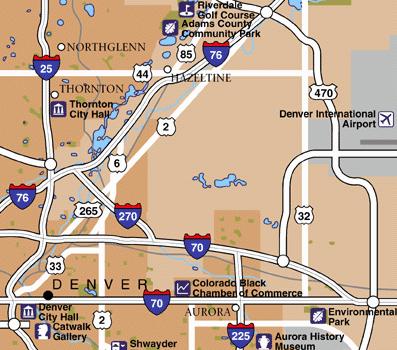
Note the airport is to the north and
east of Denver.
Anyway, the airport was north and east of the city of Denver, so we were going
in the right direction and got to Wyoming.
We stop in Laramie to get our conservation tags, and I recognize the shop:
I got my maps here last time. Incredible! Wyoming is so small that I have been
there, what, 3 times, and I already recognize the stores? I buy maps, stamp,
overgloves. They sell slings but not the clips to attach them to the rifle,
so I skip that.
Beautiful drive, lots of Lope-Lopes, gets Paul's blood going, He has a Lope
tag, I just have deer. We try Bill's cell phone (Mom did not have Craig's),
no answer. We are sure they will arrive late at night from Reno.

Arrive Rawlins 3:30 pm and easily find the truck stop where we are to meet,
Rip
Griffin's. (Paul is up to his 7th phone call.) I have been here only 2 previous
times and I still know the layout of the city, where the KOA is, etc. Frightening.
We look for Bill and Craig, no sign.(Bill chimes in: Seems he's not mentioning
that they didn't check into the motel, even though they had reservations. Wouldn't
know a concrete plan if they landed on one with their heads! And as if we had
no shopping or Gene meeting to do and would set up camp in the dark.)
Off we go to Trails West Taxidermy, to talk to Tom and learn how to size antlers.
Bill taught me this trick. It is hard to size them up in the field, but you
can teach yourself a lot by studying the antlers and horns at Tom's. Tom remembers
me, Paul and I discuss racks, back to the truck stop. As we leave, I try my
walkie talkie, just in case Bill is close. Finally, we raise them.
Turns out they got in at 3, didn't find us, did not call on cell, did not turn
on walkie talkie, and were wasting time at the motel. Miscommunication, wasted
time, no harm.
We join up, say howdys, and go off to shop. Craig gives me a list of things
to buy, plus anything I want to cook. Takes us 2 hours or so, Ted is worried
that we have too much food. (Bill chimes in: Paul worried, also. Turns out
we had it just about right. It sure filled a lot of carts! Too much salad, spam,
and candy, lousy donuts.)
It starts to rain as we bring the groceries out to the vehicles, and we pack
in the rain. I rush off with Ted to meet Gene, the outfitter, who we are supposed
to meet at 8 pm, and the rest stay and pack. Gene is on "Rawlins time",
and the guys arrive before Gene. He outlines the area and rules, is much more
forthcoming with info than ever before. We pay Gene for the trespass rights,
$1000 for deer (David, Ted, Bill, Craig) and $250 for lopes (Paul, Craig). Craig
and Bill both later remark how friendly Gene was. Seems like Ted's coyote shot,
our clean camps, our prior deportment, etc have paid dividends. We sleep at
the Sleep Inn, right next to Rip Griffin's. There is a little meeting, with
an induction and presentation of shirts.
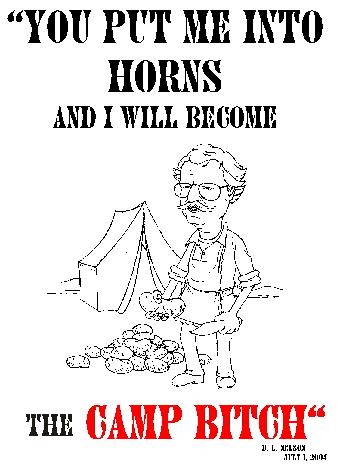 |
 |
| David's Camp Bitch T-shirt |
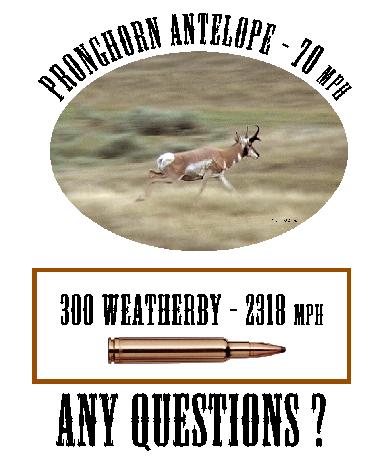
Paul's Antelope T-shirt |
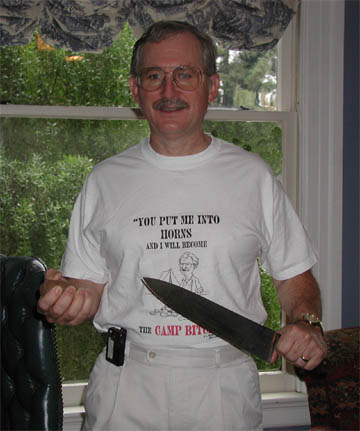
Here I am in the Camp Bitch
T-shirt, after I get back home.
We agree to an early rising. It has been raining, forecast is intermittent
rain all week. I head to bed early, the rest stay up and talk.
Thurs, Sept 30: Set Up Camp
Cloudy sky, intermittent rain, but much anticipation. Deer season opens on
Oct 1, antelope has been open (for 2 weeks?), so we are going to set up camp
and get ready today. Run into Bill Nation, the guide, in the parking lot of
Sleep Inn. He is taking older, rotund client of 15 yrs to hunt lopes, over the
Continental Divide, where it has not been raining. (I learned that it might
rain on one area but not another, just a mile away.) Craig chats with him, then
goes off for last minute supplies (rope, etc) and Paul and I gas up and fill
the water containers.
Bill goes off with Ted in his vehicle to check out some antelope ranches and
talk to the ranchers who have agreed to allow him to hunt. Bill has an antelope
tag, but did not buy trespass rights from Gene, so he will be hunting a different
area.
Craig leads the way out to our hunting area in his truck. Paul accompanies
him to talk Lope sizes and strategy, I follow in the Jeep 4WD Cherokee. Gene
thought that the McCarty Canyon Road would be too muddy, so we are going in
on the Tullis Road. One and a half hours down a muddy gravel/dirt road brings
us to a place where the sagebrush is not too thick. In Wyoming, that is a road.
We turn off the road for about 1/4 mile, find an area of sagebrush that looks
just like all the rest of the 100 sq miles of sagebrush we have been driving
through, and Craig says that this is the best area within miles for a camp,
according to Ted, who scouted it last year. Yeah, right, I say to myself. Turns
out to be a great campsite, close to all the hunting, out of the wind, has a
nice hill nearby for looking out over the landscape, actually, quite beautiful.
Ted: great choice! We start to set up camp, beginning with Craig's custom tent
(below).
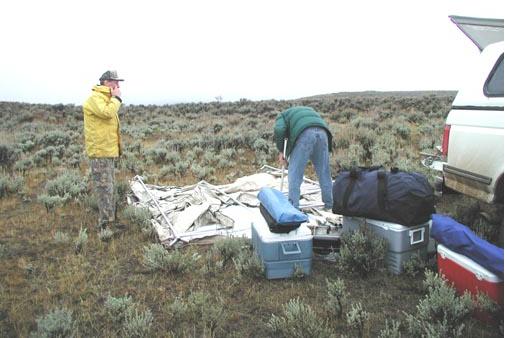
Paul, Craig, and I set up
the tent, bundled against the wind and mist
Note the sagebrush everywhere. We had to cut it out to clear the area for the
floor, kneeling down and grubbing the darn things out with a pack saw. Then
clear a wider area to set up the stakes, and then an even wider area to allow
us to walk around it. Craig's tent, a 10 by 12 by 8 foot custom Guide's Tent,
canvas, internal poles, is a marvel and great asset to the camp. We met in there,
retreated from the rain in there, cooked on the stove in there.
It was raining before we arrived at the campsite, stopped briefly to allow
us to set up (2 hrs), then rained just after the fly was secured. Perfect timing.
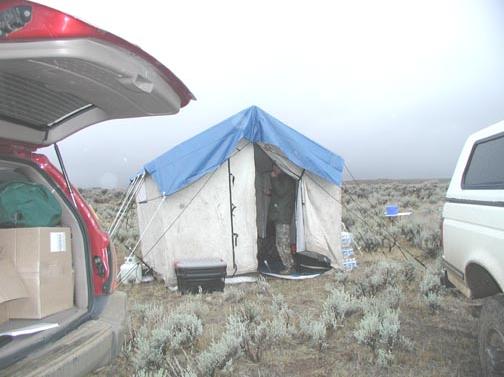
The cook tent with its rain
fly. Note the flat sagebrush field we set up in.
Paul cleared a place nearby for his tent:
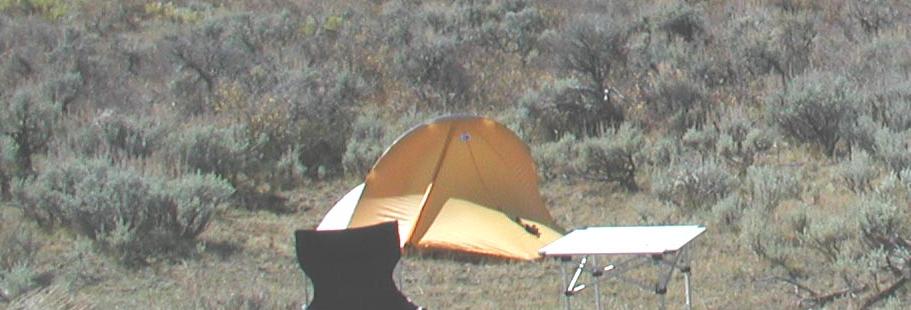
Paul set up his backpacking
tent
I cleared an area for Bill to set up his tent (I would share with him). The
plan was for Ted to sleep in cook tent, Craig in his truck, and this worked
out fine. (Bill is the only one who can sleep through my snoring. I deny I snore,
since I have never heard it, but the complaints are common, strong, steady,
...)
The three of us, Craig, Paul, and I, go off to scout Lope-Lopes, about 3 miles
away, see lots, but much too far for a shot. Will need stalking, seems impossible
given the flat ground. (Paul will prove that the earth is NOT flat, but there
are plenty of ravines to allow close stalking, but that is his story.)
When we return, Bill and Ted have arrived, Bill has set up his tent and the
cook area, and we feast on steak. (Why else did we come to Wyoming?) Plans are
laid for the morrow: Opening Day!
Friday, October 1: Opening Day
Alarm goes off at 5 am: the alarm is Craig shaking the tent and telling us
to get up. As subtle and as welcome as a load of snow dropped on your head while
doing your business. Got up, probably just above freezing, which for Wyoming
means it was warm and "balmy." (No, not a comment on our mental state
to go off and do such a trip for "fun", just the term for Wyoming
weather, no matter how cold.) Apple turnover and OJ (worried any coffee will
speed up the GI track, and right now it is too cold to take care of that business.)
Bill and I are to hunt together today, an area we call "Three Pockets."
(Bill chimes in: Being on the edge of our property, with public BLM land
beyond, I thought Three Pockets [our name] might be a good opening day spot,
with deer retreating to refuge from the sudden public pressure. [Never noticed
a deer come in.]) It is on the land we are buying the hunting rights to,
so we will be the only ones on it. (Bill chimes in: Fat chance [almost].
Although we had no one else traipsing around 3P proper, trucks were on our road
behind us all morning, trespassing.) It consists of three vales spread
out over a mile, all leading into the same sagebrush valley. (Bill chimes
in: Vales? How about 25%-grade hillside gullies with some of the densest
cover on the ranch.) (He doesn't give a guy much leeway, does he?)
Has been raining overnight, seems likely to rain today. We drive through some
impressive mud, making us get out and scout ways around it and still doing a
4 WD slide getting through it. Unless you have experienced sagebrush mud, you
don't understand. The ruts may only be 6" deep, but it is so slippery you
cannot get out of the ruts to go any way other than straight forward into the
next mud hole. (Bill chimes in: Skip the "sagebrush mud"; just
read "mud". But he's right, one just can't get out of the ruts, even
those shallower than 6". There was one spot where we simply had to go around
the mess in the road; I had to back up a few dozen yards before I could get
my tires out and leave the road.) We do not get stuck, so feel lucky. Drive
too far in the early morning dark, use our GPS's to locate our place, backtrack,
park. Civil twilight as we leave the car (can see color).
|
Here I am, dressed for the cold. Michelin man!
This is just outside the car, as we prepare to hike
to Three Pockets. |
|
Bill does not think it is cold, has no overcoat,
only one hat, no gloves. |
|
(Bill chimes in: No, it wasn't terribly cold, but I was wearing my M65
coat over a down vest, silk long john bottoms, a scarf, my orange visored watch
cap, and those wonderful mid-weight milsurp wool gloves. Whaddaya mean "only
one hat"? Who wears more than one hat?!)
We consult our maps, then walk about 1/2 mile through the sage (see pictures)
(Bill chimes in: 300 yards, perhaps.) (sheesh! I don't get to tell
my own story! I just checked the map: I stick with closer to 1/2 mi than a measly
300yds), then drop a little into a vale of Pocket #3. (Bill chimes in: Sat
just below the brow of the ridge on the far edge of #3, not "into"
what I still refuse to call a "vale".) (Alright already! Bill,
keep it down or I will boot you off my narrative!) (Lucky for me, I am the editor,
right? <g>)
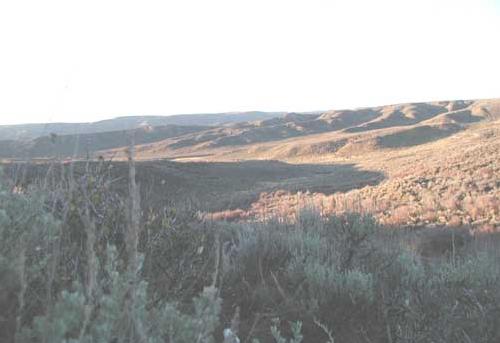
This is a view of Pocket
#3. There is a great aspen grove out of sight just below us,
and we are looking out over about 300 yds to a hillside with sage and serviceberry.
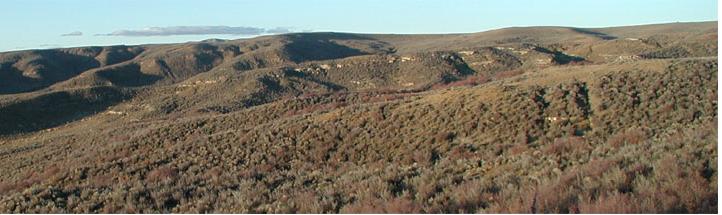
This view is of the next
ridge over, with Pocket #2 between the ridge in the foreground and the ridge
in the middle.
Pocket #1 is beyond the ridge in the middle. There is great cover for deer,
and much else, we find out.
We sit just below ridgeline, so as not to skyline ourselves. Normal cold Wyoming
breeze, but we hunker down and glass. (Bill buts in, yet again: Not even!
A slight morning breeze, is all. We might not have had a good Windoming wind
all week.) Bill sits to my right. We are close enough to whisper, so it
is a lot of fun. We see 70 elk and 70 deer that morning. Elk to 6 pts, but not
big; deer: only little things. We saw two 4 ptr.s and one 3ptr.(Bill for
once is useful: I didn't bother to count deer. About our elk - As we walked
to our spot we heard bugling, and there below us, 450 yards or so, was a group
of elk with a nice bull. They drifted west, out of sight. Soon after David began
his bathroom walk [he wanted to warm up, I can't recall how long into our sit,
so I sent him on a doggie trek] elk began coming from the west. Over the course
of the next couple of hours many elk came in, crossing the benching below us
- small groups, large groups, mixed groups, indian chiefs. They went on, past
#2 Pocket. Later, after lunch, I began a count [hadn't thought of it earlier,
plus their milling made it undependable]. Exactly 50, calves, cows, spikes,
one crowning raghorn [he should be interesting in a year or 3] and one herd
bull, crossed into the ranch from Three Pockets during lunch; after that I was
able to count the others I saw as they left the Pockets or gathered by #1 -
I came up with at least 23 more, for a total of 73 distinct individuals. Quite
a sight and entirely unexpected.)
Later that morning, the elk that we saw running/drifting to our left came back
running to our right. They cover territory, about 1 mile or more if disturbed.
Then Bill spots a rather large black bear, crossing a ridge to our left, possibly
where the elk came from. (Bill is useful again: We came back from lunch
in the car and walked to the top of the ridge between the western and eastern
halves of Pocket #3, stopping to glass. Noticed deer pouring out of the second
gully west beyond #3, west of our boundary; running out the west side and the
east- what the heck could be going on in there? Then a big black something walked
up onto a ridge bench- a big old black bear, in the sage!!)
At 11 am, I drop off the ridge, heading down and left, then cross below Bill.
I see a number of antlered deer and could have taken a shot, Bill sees about
2 times that many that I drove out but did not see. (Bill: The first thing
he drove out was a coyote. It ran onto the next hillside, near some does that
had been feeding and bedding there all morning. A little too near, in fact-
the main doe charged it, beating at it with her forefeet. Another joined in,
and the coyote ran downhill, spooking even more deer.) I walk through the
aspens. There could not be anything more beautiful than their golden leaves
fluttering overhead, golden leaves blanketing the ground, and white trunks,
parallel and thick in all directions. (Bill: Durn right, they're thick!
A tangle of aspens and willows(?), at least
the eastern grove was. That was a steep, limby, muddy, slippery walk, but full
of tracks and trails and beds.) So I decided that here, out of the wind
and surrounded by beauty, I would do my business. Kind of like using the restroom
at the Hilton just so you can see all the gold fixtures. Wonderful: branch for
the TP, branch for my coat, tree trunk for my rifle, nice level tree trunk for
my throne. Wonderful, refreshing, a moment to treasure.
Walked up to Bill (who thought I was hunting all this time), discuss what I
spooked. Some deer came right close to him, and some probably moved out through
some cover he could not see through.(Bill: I forget how many animals he
moved, but quite a few. Unfortunately I was on the edge of the top of the gully,
not above its center, so I couldn't see or block what might sneak right up the
funnel and over the ridge. I know I missed one, heard its bounding hoofs behind
me. Another deer, a fork, slipped out of the brush just 15 yards away. It noticed
me and bounded away with the same sound. While David was finishing the walk
through the aspens the stream of elk began, chasing even more deer ahead of
them. We could have taken our choice of a half-dozen 6x5 or 6x6 bulls.)
We walked back to the Bronco, rain starts, eat lunch in comfort, out of the
cold, wind, and rain. (Bill: We were just getting ready to make a walk when
the drizzle began. It was about one o'clock, I think, so I suggested we retire
to the Bronco for lunch while waiting for the rain to stop.) I snooze,
Bill takes his spotting scope and checks out Cherokee Canyon, a large draw nearby,
behind us and on the opposite side of the car from 3 Pockets. It is on public
land, I think. (Bill: Let me tell the story, will ya? Go back to sleep!
While eating lunch, we saw the elk a couple hundred yards ahead, gathered at
the fence. There were the ones that eventually made up the group of 50, plus
others. I could tell that the different bulls were trying to keep separate their
own cows. Those poor cows couldn't get a minute of peace- the bulls would poke
at them for no apparent reason, making them jump and move a few yards. It took
a long time for the large group to begin the hop over the fence and away. I
missed the hopping because I was taking care of my business right there by the
rear tire, out of the blowing mist. It was then that I took a jaunt over the
ridge to Cherokee, to watch the elk go. I jumped 14 deer where I hit Cherokee,
and they knocked out a couple more from the next erosion gully. I also saw an
interesting antelope on the other side of the canyon, so I returned to the Bronco
for the spotting scope and my rifle(!). The antelope turned out to be no great
shakes.)
Two hours later, after watching the elk herd 600 yds in front of us, on the
level sagebrush plateau, we head down to Pocket #3. We split up, each watching
a different area of the pocket. (Bill: He's leaving out our walk through
the eastern half of #2. After watching the bear we began our planned walk. {Bill,
I actually think this was after lunch and before we went to Pocket #3.}
I was to find a good place to sit up top; he was to wait 10 minutes and begin
a walk through the aspens, to a triangular formation on the bench below. I didn't
see him spook anything out but in the meantime I had several elk noisily, crashily,
come out of the aspens below and to my right. Their commotion sent one deer
sneaking out 20 yards to my right; it noticed me and ran. Other elk came in
small groups from the east, across the ridge and into my aspens, then up and
over the top. One nice 6x elk came out 25 yards away, never noticed me. I had
a lot of fun, a lot of activity, but nothing from David and no appearance of
David. My 10 minutes plus perhaps 20 minutes for him to get to the meeting spot
turned into well over an hour. I finally radioed him, discovered he'd just found
such a nice place to sit that he did! So I began my walk through the other part
of the grove, which he was supposed to observe from the triangle. This is where
I slipped on the rain-wet grass and willow branches, etc. We got together and
went on over to the western edge of #2. I sent him to where I'd sat last year,
while I continued down the hill to where it benched, and sat on the side of
a small basin, looking up and toward #1.)
Some hunters came from about 5 miles away (you can often see far distances
in this area), parked two trucks about 600 yds from me. These are adventurous
and well-equipped hunters: they must have walked at least 50 feet from their
truck, skylining themselves. No binocs, so they check me out with their rifle
scopes. I got the opportunity to watch both elk and deer as these bozos drove
up. The game had these guys spotted, even though they were between 500 and 800
yds away. They could hear the trucks from quite a distance away, watched them
get out, watched them walk around. The game got tired of this nonsense and drifted
into cover. I doubt that they were spotted by the hunters. I would wager that
any good-sized bucks would have hit the cover before the guys were out of their
trucks.
Bill is a serious hunter. I leave when I can't see to shoot, Bill does not
move until the night is blacker than his coffee. (Bill: That's the nicest
thing anyone's said about that habit. I just like to make every moment count
and then see what sneaks in in the dusk.)
We meet up at the rendezvous point at 8 pm (too dark to shoot at about 7:15)
(I began packing up at 7:20, it takes time to walk up; plus, he didn't stop
where we were supposed to meet, he went higher up the road!), walk in the
dark about 2/3 mile to truck, on a road and then on cow path through sage. Night
time sage walking is a pain, hard to find footing, tripping, etc.(Bill:
I had no problem.
During the walk, Craig radioed. He asked a very strange question, were we going
to take the main road back?! There is no other. He was at the ranch corral,
wanting a ride back to camp. Seems he was assuming that we were already in the
car and on the way back rather than still hiking toward the car. He got tired
of waiting and was in camp by the time we reached it. That's his story, and
he is stickin' to it!)
We drive back to camp and find that Paul got an antelope. (Paul: It was
about 75 m {for those of us who don't have commie sympathizer tendencies, that
is about 75 yards - David} away. I was prone shooting over my pack on sagebrush.
The antelope never knew what hit him. The horns were 15 and 15 1/8 inches. 77
0/8 score [net--'green')-]). Paul becomes camp bitch for the next day.
(This is the rule out West: the first one to get their animal becomes "camp
bitch", which means that they gather the firewood, cook dinner, etc, which
allows the other guys to spend more time in the field hunting. I did not make
up the term, we learned it from Gene, our outfitter, on a previous trip. It
is highly sexist, I know, but so was the entire West. We use the term even though
we aren't sexist: we want our daughters to grow up to be hunters as much as
we want our sons to.) We eat steak (what else?) and sit around a great sagebrush
campfire.
I retire at 9:30, the guys stay up much later, admiring the moonrise. I have
beauty rest to get, so I go to bed. Cold, windy at campfire. Freezes that night.
Saturday, Oct 2: He Never Moved
Bill decides to hunt Bird Gulch, an area that cannot be hunted with a partner,
so I team up with Ted. We rise at 5 am (same alarm clock: Craig shaking the
tent like 100 banshees), dress in the freezing weather (did not actually feel
cold, but you know that sitting for the morning hunt will be). Rain threatens,
so I dress in rain gear top and bottom, lots of clothes but not everything I
own. Apple turnover, OJ, pack a lunch, we will be out all day. Paul is camp
bitch (does the cooking, firewood, dishes), and will take his antelope into
Rawlins, 53 miles away, to be mounted, meat to processor.
Ted and I drive off in Bill's Bronco (Bill and Craig take his truck, but hunt
separately). We drive about 1/2 mile along the county road (our camp is 400
yds from this road), then take a turn off that can only be called a road if
you are feeling charitable. Not bad for Wyoming, but it really is just sagebrush
that is shorter than the surrounding sagebrush. Ted learned last year about
the quality of the road while riding with Bill Nation, a local guide. As I remember,
he bounced so high he hit his head on the roof of the truck. Anyway, you drive
slowly looking for badger holes and other booby traps. We stake out a low area
at the head of a draw (becomes a creek further down the draw) that is free of
sagebrush. There is a field off to our right that is cut and bailed, so it might
be alfalfa. Ted thinks that we may see something come from the field, through
our draw, and into the creek. We see one jackrabbit. An hr or so later we drive
further down the canyon, get out and glass. See deer, but often >500 yds
away. Drive further, drop off into a canyon, glass the area, again often 600
yds or more. See about 15 deer, including a thin 4 ptr with does. The big ones,
prior to the rut, will be by themselves, so a nearby doe is almost always a
sign of a small one. Ted uses his spotting scope, we can see Bill and Craig's
vehicle at about 1-2 miles away, on the far side of Bird Gulch (an 800 ft deep
canyon). (Bill chimes in here: Perhaps 450 at its deepest. I checked
the topo: 12 contour lines means 480 feet, so Bill is right.)
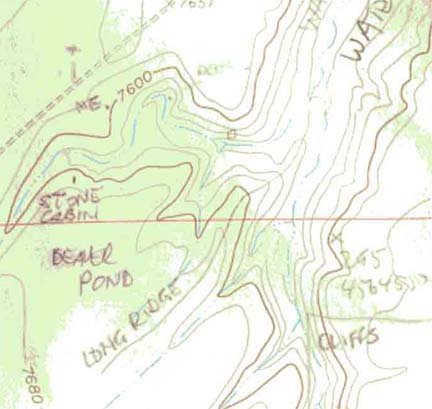
A map of the hunt, centered on Waterfall Gulch.
I hike in from top left, end up at point marked "me".
The location of the deer is indicated by the light dot, almost due east of "me"
and indicated by a very light label "deer".
Finally, we drive to the main day's hunt, about 1 mile away. We navigate the
badger hole of last year, park where the road washed out. We check our maps,
make our plan. There is a canyon system ahead by 2/3 of a mile, Waterfall Gulch
(my name, after a 15 ft waterfall; there is no name on the map), about 150 feet
deep, 300 yds across, and several miles long. It finally drains into Bird Gulch,
near where Bill is hunting, several miles away. Ted is to walk about 1 1/2 miles
around to the right and then the far side of the canyon. I am to walk about
1/2 mile forward, NE from the Bronco, and sneak up on the canyon edge, drop
down and sit. We split up. This is the first time I have been navigating and
hunting on my own, with so far to go. I note on the map that I have to cross
one ravine, 40 ft deep or so, and then stay on course through the sagebrush
to my sitting spot. Ted and I have discussed which ridges might be the best
for hunting, to see what he might drive out, and to see to the far side of the
Waterfall Gulch.
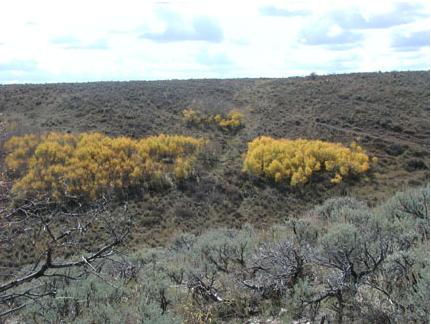
This is a view across Waterfall
Gulch, to a patch of aspens on the far side.
The sage in the foreground is on the close side of the Gulch.
You can get an idea of the size: it is about 300 yds across.
I wend my way through the sage and can watch Ted as he walks along his path,
and then disappears as I drop down into the 40 ft ravine. I come out the far
side, wending my way through the sage. (Unless you have walked through sage,
you do not know what "wending your way" means. You cannot walk a straight
line, but first wind your way around first one sage plant and then another.
Look at the photo above, with the aspens. Look at the close hillside, in the
lower part of the photo.) They are too stiff to walk straight through, too tall
to walk over. You must "wend your way." If the devil himself wanted
to design a torture for the hiker, he could not do better than sage.)
As I walk up to the Gulch, from about 300 yds away, the sage seems to stretch
as far as the eye can see. We are mostly on a sage tableland, fairly flat, with
canyons cut into it. From this distance, when glassing with the binocs, there
seems to be unbroken sagebrush flats stretching forever out in front of you,
and then the Gulch seems to appear from nowhere. First you see a bare distinction
between one edge of sage and another, then as you get closer you see a definite
gap but nothing more than a lip (see above photo for an idea of this; the photo
was taken just over the rim into the canyon), and then finally, from 50 yards
away, you see that it is a sizable canyon. (Bill chimes in here: True of
all of it, and a heads-up for the hunter- there's a lot one cannot see unless
on some high hill, so be ready for anything to appear anywhere, and don't ever
say, "Ahh, there's nothing here.") This is where you need to
be walking hunched over, because game in the upper parts of the Gulch can see
you. I see some serviceberry bushes along the rim, so I head for these, as a
good way to enter the canyon.
Waterfall Gulch is a very pretty little canyon. The rim has scattered serviceberry
on this side, which helps to define the close edge. As I get closer, I can see
a glorious grove of aspen, now in full golden glory, on the far side.
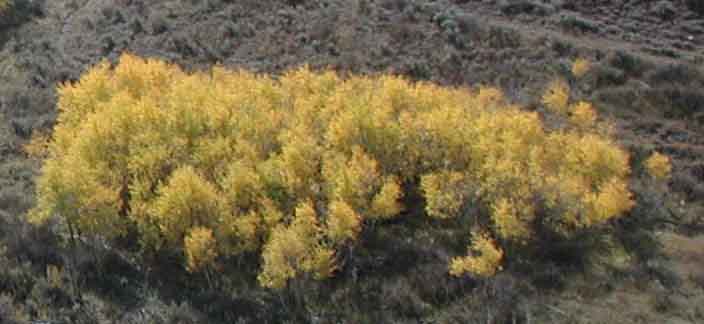
Aspens in full glory
When I am about 100 feet back, I crouch, then finally crawl to the rim, directly
behind a serviceberry, about 6 feet tall. Ted had warned me that the deer could
be anywhere, and not to skyline myself, so I try hard to sneak in. Once behind
the serviceberry, I am over the lip far enough that I can see the creek below
me, and sure enough, there is a 4 ptr and another smaller antlered deer, about
300 yds from me. I move around a bit, moving forward, but then cannot see the
deer. The valley floor has a lot of infolding and cover, so they were hidden.
I did not like my view, as I could not see anything to my right, so I backed
up, crawling, moved back into the sagebrush for 100 ft, move to my right about
200 feet, then approach again, crawling. Move pack one foot forward with my
left hand, move my rifle one foot forward with my right hand, crawl, glass with
binocs. Repeat, for 50 feet. I finally get into the serviceberry bushes, about
30 of them, each about 6 ft high and without leaves at this time of year (see
photo below). I glass the area and pick up a lot of deer. About 600 yds away
or more I see a large 4 ptr, seems to have golden horns in the morning light,
big, but too far away and on the far side of the canyon. I hope Ted can see
him. I see several small antlered deer. To my left, across a small side canyon
(in photo below, the side canyon is in center and extends to the left), I see
a deer bedded down, and it takes less than a millisecond to see it is big. There
are deer above him feeding including a small buck, but the big one is bedded
down, alone, under a serviceberry bush and well hidden by tall sage. If you
were hunting that side, you would never see him until he jumped up from under
your feet. It seemed as if the ground had been dug out a bit, which made the
bed even deeper and more hidden. The serviceberry tree was all by itself, you
would not have thought anything would be there. Perfect hideout. You could only
see it from my vantage point, across the side canyon. This was a big one, all
by itself. I glass it again, studying carefully. His butt is to me, his body
almost completely heading away, just a tiny bit to the left. He is facing left,
resting. He never moved.
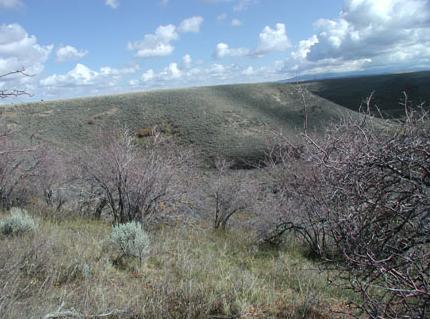
This is the group of serviceberries
that I was hiding in, the buck is directly across the side canyon in front,
the main canyon is to the right. Note the tableland around the canyon.
I looked off to my right, into the main canyon of Waterfall Gulch. There was
a small stream at the bottom, just barely flowing in this fall season. I could
see a beaver dam in the distance, where the stream flowed almost straight away
from me. The sides of the Gulch are fairly steep, probably between 30 degrees
and 45 degrees, in various places. A long ridge came in from the right, extending
off to the right as far as I could see to the sagebrush flats. There was a group
of what looked like willows where the ridge dropped into the bottoms. Upstream
and closer to me, the stream took a strong bend to my left to get around another
ridge, then took an almost 180 degree turn to my right, then flowed below my
grove of serviceberry, disappearing to my right. The far side of Waterfall Gulch
was about 300 yards away, mostly covered in sagebrush. The bottomlands are covered
in a grass, about 12" tall. On my side of the canyon but downstream from
my hiding place, and just opposite the 180 degree bend, a smaller side ravine
came in. The entire place was beautiful, with great cover for deer (and hunters!)
Right now there were at least two 4 pointers and a dozen other deer in the Gulch.
I was psyched! I looked back at the big one in front of me.
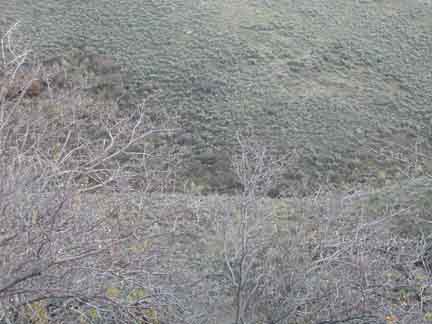
Looking
at the hillside, with my deer in the middle, the pale dot in the dark patch,
just over the ridgeline
(If you can't see the deer, click here.)
This is a magnified view of the center of the above photograph.
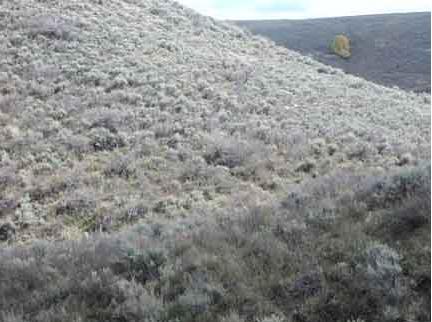
The hillside where my deer was bedded
down, deer in center
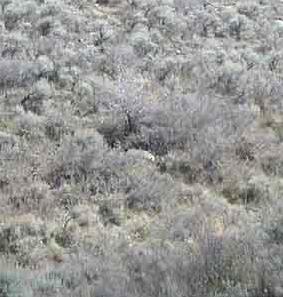
Magnified view of above, deer is pale
object in center, below a serviceberry
I looked at the buck with my binocs. The forks started above the ears and he
had very good mass. He was looking to the left and I could see the length of
the tines. They looked good, but I could not check his spread, as he never looked
directly at me or directly away from me. He was solo, laying down hiding when
the other bucks were up and feeding: an indicator that he was an older and more
experienced buck. He had possession of an obviously prize hideout, so he had
beaten out his rivals for his resting place. I made up my mind: he was big,
and certainly good enough for me. He was the largest one I had seen so far and
certainly within shooting distance: I guessed 270 yards. Many times on this
trip we would be checking out bucks out to 600 yds and beyond. Craig, Ted, and
Bill think nothing of using their spotting scopes to check out things at a mile
or more. Those would need to be stalked to have any chance of making the shot.
That made 275 yds seem very close. I decided this one was for me.
So I sized up the shot. I guessed 270 yards, so this was eminently doable,
but I would need a rest to be sure of the shot. This might be the only one of
the entire trip for me, the deer looked rather good, and I was not going to
waste the chance by a sloppy shot. In addition, the hunt and the game deserve
a clean shot. Where was I going to find a rest? In addition, I was in the upper
1/3 of the serviceberry grove, and did not have a clear shot.
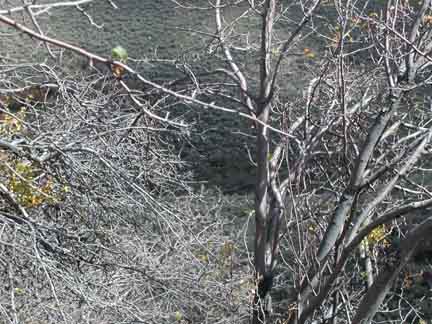
The clear area in the center
was my shooting window
I could see the deer through a small opening in the trees, but not enough to
clear the bullet flight path. I did not want to spook any of the deer that I
could see on the hillside above my buck, or any of the deer elsewhere that I
could see, or any deer that I might not have yet seen. Any ruckus would certainly
start my buck from his well-hidden bed, and I would not be able to risk a running
shot at 270 yds, even if I could see him through the serviceberry branches.
I would have to move quietly and slowly. I decided to move forward, closer to
the edge of the serviceberry thicket. There was an opening in the branches that
I was sure I could shoot through. The ground was sloping downhill at about 45
degrees, so a prone shot was out. I would not be able to get close to the trunk
of the serviceberry at the perimeter of the grove, due to branches that extended
towards me. I needed a shooting stick. All the growth near me was small stuff
or rotten. I could see a sagebrush branch that was thick, long, and dead, and
it was along the path I would have to take to get into shooting position, about
15 feet away. This was the branch for me.
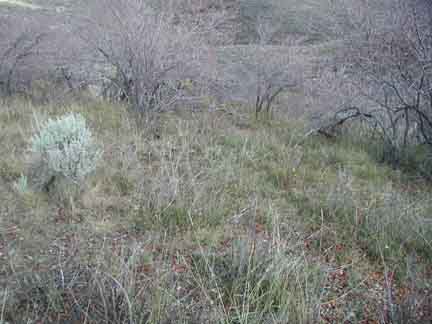
The path that I butt-scooted
I did not dare stand, and did not want to try to move forward on my belly due
to the gradient and the fact that I would not be able to keep an eye on my quarry.
I was sitting, and I figured sliding forward on my butt would be easy and not
involve much motion. So I checked the buck (had a hard time locating him through
my cover) and started to butt-scoot. I left my pack behind, taking only my rifle
and binocs. I got to the dead branch, checked the buck (he never moved), and
balanced the gun across my lap. I stretched out far to my left and tried to
move the branch: still well attached to its roots. Dang it. I checked the buck,
then fiddled around and got my knife out of my pocket. I tried to cut the branch,
but it was rock-hard and I was in an awful position to try to put any force
into the cut. It was slowly dawning on me that the time to cut a shooting stick
was not after you sighted a great buck! I tried to break it again, no luck.
I tried the knife again, but that was a really lost cause. No dice. I pondered,
then decided to take a risk. I laid out to my left to get better leverage on
the branch, then gave a grunt and broke it. It made one hell of a noise. I just
laid out to my left, not moving. Finally I sat back up and glassed the buck.
He never moved. I took the branch and tried it. Too short, too flimsy, too late.
Rats! All that aggravation and all that risk, for nothing! I looked forward
to where I thought I could take the shot, about 20 feet away. There was a likely
stick there, so I went back to butt-scooting after checking the buck. Head still
to left, body almost straight away from me. He never moved.
As I butt-scooted, I noticed that there was a prickly bush in the way. I would
have a hard time maneuvering around it, so hell, prickly bush, here I come.
What is a few prickles in your butt if you get your deer? I got to the stick,
it was not attached to anything and it was about the right length. A bit long,
but I could place it well downhill from me and it should be fine. I checked
the buck, no movement, and butt-scooted further toward where I hoped to take
a shot. When I got there, another branch was in the way, but it looked as if
I would have a clear patch about 6" by 6" if I moved another 3 feet.
I checked the buck, he never moved, then I butt-slid further down. Checked the
buck, placed the shooting stick into the ground about 3 feet in front of me,
then took off my gloves. I used them to pad the rifle stock from the shooting
stick (so the recoil would not knock my shot off). I sighted through my scope
and checked out the shooting stick elevation, had to move it down a bit more.
Sighted again. Good. Took another glance at the branches. I knew that a branch
could be in the way but so out of focus through the scope that you could not
see it. No obstructions. I went over everything to make sure this shot did it.
If he bolted, I would not get another shot through the serviceberry. Bill had
told me, place your shot so that if it goes high, you are still in the kill
area. I sighted through the scope. The deer never moved. He was lying almost
directly away from me, with just a little tilt to the left, and facing left.
It would be a very awkward shot, but as he had not moved more than one ear since
I first saw him, I did not want to wait for him to take a stretch. I would have
to enter the left hindquarter at its upper half to get the bullet to the boiler
room. He was lying such that any shot that went high would go into the base
of his neck. Bill had put a lot of time into the gun, rebedding it, replacing
the trigger, sighting it in. Last time we sighted it in, the first shot was
still about 3" high, the rest grouping well. But most of the time, only
the first shot counts, so I had a problem. He said to aim at the junction of
the lower and middle third and I could not go wrong. I sighted the deer through
the scope. The deer was definitely not as thick from spine to belly as I expected.
He must be lying just slightly on his right side, and it could be that at rest
he was not as thick top to bottom as when standing. The placement looked right:
upper part of left rear quarter, vertical cross hair on the middle of the neck.
Double-checked the window: no obstruction. I checked my position: left leg out
straight, right leg bent to steady my right elbow, leaning forward, gun padded
by gloves on the shooting stick. I placed the cross hairs on the deer, decided
I could make the shot, then slipped off the safety. I peered through the scope,
watched how high my breathing moved the cross hairs, tried to calm my heart
and breathing, placed the cross hairs in the center where I wanted them, and
put slight pressure on the trigger. All of the Wyoming trip depended on this
shot, but I was ready and steady. Increase pressure.
Bang! I was barely aware of any trigger pull. The gun just seemed to go off,
with my cross hairs where I wanted. I barely felt the recoil. I don't remember
ever losing sight of my quarry, just saw his head drop, nothing else. He never
moved. I stayed on point, in position. He never moved. I was quite confident
of a solid, clean kill. Then I thought, if you need to take another shot, it
would help if there was a live round in the chamber! I tried to eject the shell,
but it came out of the ejector and sat there. I fished it out, placed one home,
and looked. The deer's head was down, the body was in exactly the same position.
He never moved. It must have either been a spine or a neck shot, or else the
shock to the boiler room that he did not react. He had been at rest, not poised
for flight. In any case, he never moved.
I checked my watch. 12 noon plus 20 seconds. I made up my mind to stay on point
for 15 minutes. I check him out again, nothing. At about 4 minutes after the
shot, there was a convulsion, the rear legs kicked, he pooped, and the head
fell even lower, and there was no motion again. I guessed it was a muscular
reaction to anoxia, and knew I had my deer down for good. (Bill chimes in
here: Love the attention to detail! Some folks miss because they were watching
antlers through the scope; David, on the other hand, ...) Slipped the safety
on. I keep watching him, then checked the other hillsides. At about 10 minutes,
Ted comes over the radio.
“Did you shoot?”
"Yes, deer down.”
“Is he a good one?”
“I think so.” (Now is not the time to brag.)
“Congratulations, I am coming over.”
“I got it, you keep hunting.”
“Are you sure you got it covered?”
“Yes.”
“Thanks. Ok, I’m off. See you later.”
It was very nice of Ted to offer to help. Certainly, I am not as experienced
as Ted, Bill, and Craig, who each have killed at least half of God’s creation,
but I had gutted a deer once all by myself (took 4 hrs) and had practiced field
quartering with Mike on the final weekend of deer season 2 years ago (Mike’s,
mine, and Paul’s deer; repetition over a short period of time is a great
way to cement it in your mind), so I was sure I could handle it. The day was
early, Ted had his own tag to fill, the area was rich with game, there was no
need to rain on his parade just because I had one down. But I certainly appreciated
his offer to scrub his own hunt to help me. Teamwork and camaraderie count.
I looked at the deer through the binocs, made sure I knew where he was, what
my landmarks would be when I was on the hillside.
I got my things together, made sure I left nothing, and went back to my pack.
I took a few pictures, lasered the distance (235; I had guessed 270; not bad.
Bill chimes in here: Lasering can aid in finding your animal-- once on the
animal's hillside, laser back to where you'd been sitting, move around until
the distance is the same...) then returned to the rim, and walked toward
my deer. I noticed that he must have been lying in the same place when I first
peered into the gulch behind the very first serviceberry. He must have been
directly in line with the trunk. I had leaned to right and left to see, but
tried to limit my motions since I had seen a 4 pointer right off the bat. Must
have missed seeing him. Also, I noted, that although he was facing in my general
direction, I had moved so slowly that he never saw me. I dropped off the rim
and worked my way down into the gulch. I was working myself up to the challenging,
nay, the daunting task of field quartering him. The day was very mild, warm
even, with clouds in the sky, maybe even gathering clouds now that I thought
of it.
I get down to the creek bottom, cross, go across the short ridge that makes
the creek go through its 180 degree bend, cross the creek again, and walk up
to the deer. He is about 35 feet from the creek bottom, about 150 feet from
the rim. Craig said that they like solitary lookouts, well hidden, but higher
rather than lower, so they get a good view. The one I had gotten two years before
had been in such a position. Well, it was almost all according to script. I
filed that away for future reference.
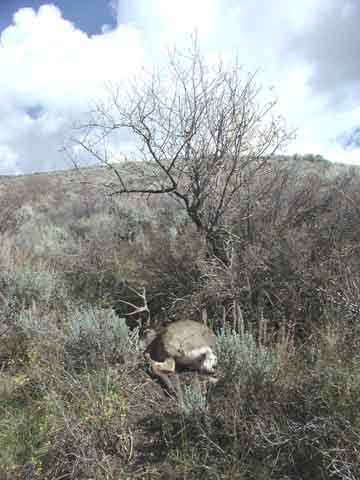
Deer downed.
I came up to the deer, poked him with the rifle barrel, no movement. I checked
the shot placement. There was a furrow along his back, just over the shoulder,
where the bullet skimmed his back and went into the base of the neck.
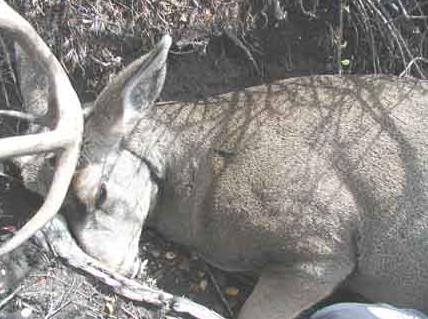
Shot path in neck is the
dark line between neck and shoulder
He had dropped so quickly because it was a neck shot. I inspected the deer
bed. Besides the overhanging serviceberry tree to give both shade from the sun
and cover, the sage below him was rather tall. The bed also seemed to have been
dug out by generations of deer hooves, as the back side was dug about 18 inched
down into the soil. It was a great spot.
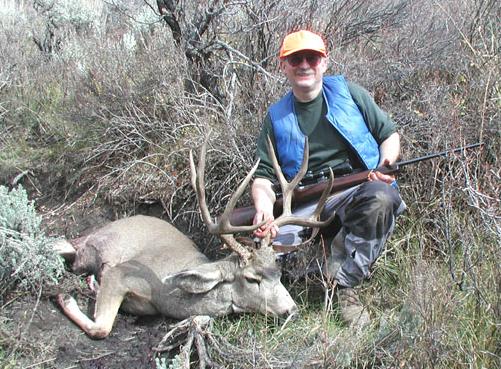
Successful hunter
I placed the rifle in a safe place, took off my coat, took some pictures, got
out the deer bags, opened them up and placed them within reach (when you are
holding a hind quarter that weighs a ton is not the time to think about opening
the bag or putting it within reach. Ask me how I know.) I started in, working
slowly but correctly, trying to spare my short blade when I could. I lost my
big single-hand knife, meant to get another but never did, so I tried to preserve
the blade, esp the tip. Did the rear quarter, dropped it into a bag, left the
hoof on and set it aside. Quartered out the front, bagged it, and Ted arrived.
Admired the antlers, again congratulated me.
I was glad he was there. I was a bit tired, there was a lot of work to do,
and a ways to the car. I glanced at the sky, it looked worse, probably was going
to rain, maybe more. There was thunder in the distance. Ted sized things up
and offered to go to the car for the frame pack. Hadn’t thought of that.
He helped me flip the deer over, take some more pictures (now with me and the
deer; previous pix were just of the deer). He took the forequarter and headed
out. I keep working. Sky thickens, clouds rumble, and I work on. Physically
demanding, mulies are bigger than blacktail, and with no one to hold the leg
when you need to skin out the inside. No ticks or fleas that I can see. Good
layer of fat. I did the second rear quarter. This one I hung in the service
berry, to let it dry before I place it in the bag. Lacking any piggin strings,
I weave the hoof into the branches. Then the forequarter, into the branches
as well. I am working away when the hail hit. I went down to my pack, got on
my jacket, tried to cover up the gun with my pack, hardly successful. I hate
to see a good Dutre gun getting rained on, but not much to do about it now.
Meat also is getting wet. I go back to work, but it is work. I took off the
head at the base with my knife. We did not have a saw, so there was more weight
to carry: the head. Knife getting dull, I am very tired. Ted arrives. I realize
I have not done the back strips, and now there are no legs or head to help roll
the deer over. I do the job, bag them, while Ted cuts the hoof off one quarter.
We find a saw in Bill’s pack, and cut off the antlers. We pack the meat
into the frame pack, all but one, which goes into my rucksack. Ted estimates
the frame pack weighs 70 pounds. I look at the hill above us and groan internally.
It is my deer, so it is up to me to pack it out. I am wondering about my sanity
when Ted just picks up the frame pack, 70 pounds heavy with my meat, hoists
it to his shoulders and starts off. I grab the rest, plus my gun (we forgot
to have Ted take it out when he went for the pack), unload the gun, and follow.
I start to make a comment about the course Ted is leading us, he suggests it
might be better if I just keep my opinions to myself. He is carrying the weight,
so he is going to choose the path. I see eminent reason in this and follow quietly.
Hail had been short lived, then rain. Now it was threatening but not actively
raining.
Ted carried the load to the rim and quite a bit more, then heaves it to the
ground. We trade packs, but I cannot lift the frame pack up, so he helps me.
I look like a bent-over dwarf and feel worse, but we head out through the sage.
We trade one more time before we got to the car. We celebrate with a beer each
and I eat lunch. It is now 4 pm. Very tired but very happy.
I owe Ted big-time. He sent me to the place where I spotted the deer, he offered
to give up his hunt to help me, and then he went far beyond the call of duty
when he carried the pack up out of the canyon and then some, all after hiking
several miles. Great comrade who did a lot more than he needed to. Thanks, Ted.
I think he was happy, too. He said that it was the first time he had guided
anyone onto a deer. So we both had a good day.
This was a very fortunate hunt for me, and it depended on the help of a lot
of people. Bill contributed a huge amount to this kill. From reloading my shells
and sighting in my gun, not to mention all the work to remount the barrel to
see if we could cure the errant first shot, to all the other details of organizing
the trip: which maps to get, bringing supplies for me, not complaining when
I forgot something, etc.
Craig was the main honcho setting up the outfitter and trespass permission,
camp gear esp his custom $1200 main camp tent, cooking gear, etc.
................................
We headed back to camp in Bill’s Bronco. We unloaded the meat and placed
in on some sagebrush to air dry. The rain was gone, and this was typical of
the trip: the rain as short lived, and often we could see rain in one region
of our hunting area but not in others. I sat around and rested, Ted had a beer
and headed back out, I don't remember with whom. After a little rest, I gathered
some sage firewood then started into cooking dinner.
After all, I had promised that if they put me into horns, I would be the camp
bitch. I was cooking one of my culinary specialties that is the envy of the
cooking world, Speans (spam and beans).
Although Paul had protested earlier about anything cooked out of spam, and
insisted on cooking his own dinner if I made the spam.
When the guys came back in, well after dark (Bill was the last one in), I served
up chicken Ramen, then Speans with flour tortillas on the side (Paul cooked
these up over the grill). No complaints, all compliments, and even Paul ate
it without resorting to cooking his own dinner. Not his favorite, but he ate
it.
I retired early, with the boys staying around the campfire, discussing the
hunting of the day.
Sunday, October 3: Rest Day in Camp
I slept in the next morning as the guys headed out. Paul was done with his
rest day and was to go out scouting antelope, experimenting with using terrain
to sneak up on them. I got up at 9:30, and was very glad for a rest day. I was
tired. The day was clear for a change, with hardly any clouds. The temp actually
hit 74 degrees, a record for our Wyoming hunts. It was so hot, I had to hide
in the shade of the cook tent. I had a leisurely breakfast of coffee and donuts
(this was the first coffee I dared drink for breakfast), sat in one of Bill’s
camp chairs (sure beats the heck out of sitting on a log [there were none here]
or the ground), and wrote in my Journal. When the call of nature came, the sun
was shining and the wind nonexistent, so I enjoyed a comfortable call. I would
alternate between gathering firewood, pulling out sagebrush from the pathway
from the tent to the fire or the water table, and sitting & writing.
The day was absolutely glorious. Although it started cloudless, around 1 some
fluff gathered on the horizon, then some real thunderheads and heavy rain off
about 5 miles south. At 2 pm, the first cloud shadow passed over camp. The temp
dropped a lot. Although I was more comfortable sitting in the shade of the cook
tent, it was more for protection from sunburn, but it was not cold. When the
cloud shadow passed over camp, it was cold. An amazing temp change in just seconds.
The whole sky was then studded with puffballs. I took a sponge bath in the cook
tent, without being in the least cold even when I was totally naked. (Bill
chimes in here: With these and the deer pooping, I agree with Eric's eye-gouging
idea. It hurts just to think of the scene.) Felt great to get clean and
change into new clothes. I was comfortable in a T-shirt, long johns, and camo
pants, without any jacket, etc.
Gary, a retired local policeman and prison warden, hired by Gene our outfitter
to chase off poachers, came by. I offered him coffee and we talked for about
45 min. He does not try to get too much done in a day. I think overwork will
not be a problem for him.
I started work on the pot roast, removing all the fat and searing it in the
dutch oven. I add some water and get back to writing and lounging. There is
an occasional un-Wyoming light breeze. It fluffs up your hair rather than pierce
your bones. The warm sun brought out all sorts of insects. I saw four different
species of butterflies float by on the breeze. The first was like a buckeye,
dark with red accents, about 1 1/2 in. The second was yellow and black, with
fine markings like a fritillary, not bold like a Tiger swallowtail; about 3".
The third was high, being buffeted by the breeze; red, may have been a monarch,
about 3 1/2". The last was yellow, like a common miller. Two bee flies
come by, sunning themselves (a mistake: I collected both of them). A very large
black-and-red robust bee came by, acted like a solitary bumblebee. Many smaller
wasps flew around and kept dying in the pot roast juices that I poured off,
the better to fry the meat. I did not think that they would add much flavor,
so I scooped them out with a spoon. Two ladybugs were sighted, crawling in the
sage; a few spiders on the ground; and many common flies.
Bill came back into camp early, having bagged his deer at 340 yards.
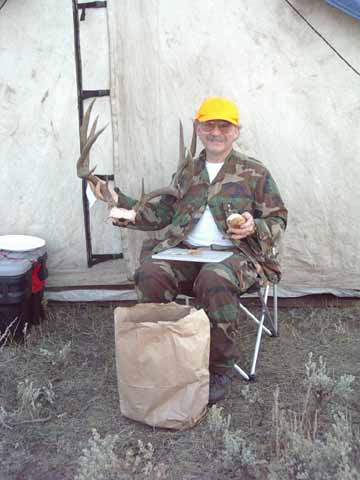
We chat as I cut up the potatoes for the pot roast, then remove the hair from
my antlers. Bill showed me how to count the points according to Boone &
Crocket: 162 gross, 153.5 net (lost points for asymmetric eye guards and a very
few for asymmetric girths of R vs L sides). Very respectable.
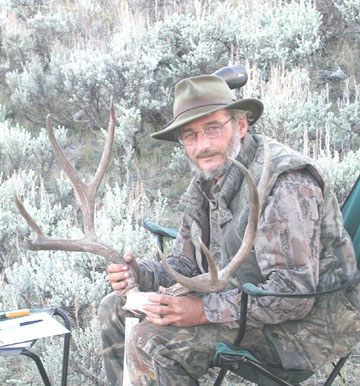
Bill in camp the day he got his deer.
Ted came in, hiking across the sage. As his grateful subject, I headed out
across the sage with a cold brew. He smiled when he saw it and was happy to
see it.
The rest of the guys came in, no one got anything further, but this was great:
Three animals in three days: Paul (antelope) day 1, David (deer) day 2, and
now Bill (deer) day 3.
I serve up the pot roast without any delay, all appreciated it. (Cooks always
respond best to compliments, so the guys did their job and I will cook for this
group, anytime.)
Had a bad cold, coughing and sneezing like crazy, for the last few days. Felt
much better this day and next.
Monday, Oct 4: Off to the Woods Again
The next day I felt rested and ready to go, so up at 8am and relax around camp.
Finally, at 10 am, Paul and I headed out to Three Pockets. We parked beyond
the gate that Bill and I found after our hunt. This hides our car from the public
road. The clearer weather had dried out the roads in most places, mud was not
the problem it was a few days earlier. Gene, our outfitter, had told us that
a few hours of sun or wind would dry out the roads. This is somewhat true. It
will dry out the roads in general, so that there is less mud. However, the really
low-lying areas that are the problem (muddy flats are not an issue) take longer,
and will still be there days later. They may not be much of a problem, but you
don't know until you are stuck if they are a problem.
We hiked in and sat near where Bill and I sat. We saw no elk and fewer deer,
drove Pocket #3 (I walked through low down, Paul up higher) but scared out nothing.
We walked out the road, arrived at camp around 3.
Rested up some more, then joined Craig and Ted in the evening hunt. They drove
in to the north side of Waterfall Gulch and hiked to the south rim. I drove
the county road, called Brown's Peak Road, around to the south-east side of
the Gulch, drove through the Red-Green Gate, located at 4563300N
by 295500E or so, then drove straight north. I parked
at a fence corner and, using my GPS, navigated over to the "x" in
the map below, about a 1/2 mile hike through level sage.
The "x" on the right side, middle, with "295" below it was
where I sat in the evening of the 4th..
I knew this area from looking around the sage from where I shot my deer. The
plateau is quite level until near the edge of Waterfall Gulch, so I knew I would
have to be very careful coming up to the rim. I was not hunting, did not have
my rifle, but I did not want to scare any game. I moved forward crouching when
I was about 300 feet back, then went to crawling along. Somewhere along the
line I discovered I had lost a glove, so I left my pack and back tracked. Hard
to tell where in the sage you have been going, so it took some time. Then I
had a hard time finding my pack. Slow to learn a lesson, I then later found
that I had lost my GPS and my map. Not the thing to do a half mile from your
car on a featureless plain, so I backtracked again and failed to find either
GPS or map. I was not a happy camper. How could I not see a white map at 15
feet? I did not feel I could be off by any more than that. Eventually I found
some tracks and could localize my path. I covered at least 150 feet back into
the sage. No GPS, no map. It was getting so that I could not tell where I had
searched and where I had left my pack. I started placing bits of paper towel
high in the tallest sage to mark my path.
Finally I did find them, about 50 feet back from my farthest point forward.
Lesson: close the flaps on your pockets when you go to crawling, as the brush
scrapes away at your sides and can pull things out of your pockets. I am sure
Craig and Ted, who I could see about 800 yards away (at the point marked "Stone
Cabin" on the map, above, just slightly north of due west of me) were wondering
what in tarnation that Nelson was doing. Very frustrating, lots of valuable
time lost, lots of excess exposure to the quarry. Ugh.
When I finally got to glassing, I could see a thin 4 pointer on the far side,
due north of me, with a yearling. The sun was directly in my eyes when i looked
over to Long Ridge, which was where I had seen the large 4 pointer with the
yellow-toned antlers. This made the viewing difficult in the main direction
I wanted to see. Both the brightness of the sun and the reflection off my lenses
(it sure makes the slightest dust speck on your binocs glow, and any oil becomes
a filter) made it tough until the sun went down. I could see way off to my left,
almost straight south of me, some white cliffs (see map). I am not sure, but
think the waterfall must be back this direction. The lines around the word "cliffs"
is the boundary of our ranch, that is, the limit of our hunting area. I was
in bounds, the cliffs were just out of bounds.
I finally picked up a pair of 4 pointers, rather thin, along Long Ridge, but
away from Craig and Ted, as well as some other antlered deer that were smaller.
After dark, I walked back to the car. I had not taken a GPS reading of the
car, but knew the location from the map. I did it by dead reckoning and was
only about 300 feet off. Came up to some cows, who stampeded ahead of me. They
are about as brainless as they can be and still breathe.
Dinner was pork steaks and hash browns. The hash browns made the meal for me,
and I heartily recommend them for future trips. (Craig left them on the stove,
rather underdone, so I sneaked up and fried them up proper.)
Tuesday, Oct 5: Traipsing with Craig, hunting with
Ted
Up at 5 am, left camp at 5:30 am (Craig does not like to be kept waiting, and
as I was just his tag-along, I made sure to be ready early. We were supposed
to leave at 6, but I was ready ahead of time and we left early.) We went to
the north rim of Waterfall Gulch, where I had shot mine from, and entered into
the serviceberry thicket. Craig went a bit right (west) and I went a bit left.
I found it hard to find a good viewing spot, since the serviceberries blocked
a good part of the view. We were there before first light, but within about
15 min of arriving, could see deer. I looked around for a bit and then saw a
5 deer bachelor herd with two 4 pointers. They were not huge, but good. I tried
to radio Craig, but he had mush in his ears (or did not turn on his radio),
so finally I got up and moved about 100 feet over to where he was. He had seen
them but was more interested in two aspen groves across from him (the same ones
in the photographs much earlier, "View across Waterfall Gulch" and
"Aspens in full glory".) We don't see anything more with antlers and
finally move on.
Craig then took me on a long, wandering hike among the sage, inspecting various
creeks and gulches. It was a good exposure to his style of hunting and I was
glad to be able to learn how he does it. We first went north to an unnamed gulch
I am going to call Middle Gulch, as it is between Waterfall Gulch and Stratton
Creek Gulch. One of the originating fingers to Middle Gulch is the depression
we had to walk across each time we went from the car, parked at Washout Parking
Lot, to Waterfall Gulch. We walked down this, spooked out a bunch of does with
one dinky fork. We followed them down the peninsula that is formed between Middle
Gulch and Waterfall Gulch, then crossed over to look at Waterfall Gulch below
the beaver dam. Not much, but we see some elk taking shelter from the sun in
an aspen grove. Craig finds some 4 pointers in the aspens as well with his scope,
but is not interested in checking them out further. It would take some long
up and down walks, but he is not interested. I would have gone for it, but here
I am only the tag-along. I have filled my tag. We then walked back to the car,
a walk of about 3 miles, but almost all level. The only aggravation is the Sagebrush
Waltz, dodging those dam#@! sagebrush bushes.
We drove back out part of the way to the county road, but then took a 180 degree
turn to drive out the peninsula between Middle Gulch and Stratton Creek Gulch.
It was good to see some new territory. The sage gets smaller and sparser as
you near the end of the peninsula, until the ground is merely gravel. All the
dust has been eroded away. We could see into Bird Gulch, the major depression
in the area. Not much in the way of deer. We drove back with some dramatic gathering
of clouds and rain off North of us, and took a turn north toward Stratton Corral.
Craig spotted a rather large antelope far ahead, but this one was very wiley.
I am guessing he started off at about 300 yards away but soon made it 600. We
tried to move quickly on the road, taking it down into the gulch of Stratton
Creek. The antelope must have covered at least a mile and was still pulling
away from us. The road started going downhill, down the steepest downgrade I
had yet encountered. There were some ruts that would rival the Grand Canyon
(at least 5 feet deep) and the road had taken some new twists and turns trying
to stay away from the ruts that had developed over the years. Craig did some
fancy driving and we bounced ab it, as only his truck can bounce. The clouds
thickened overhead and we knew it was going to rain. We came to a small bridge
over Stratton Creek, just a hundred yards south of Stratton Corral. It had been
badly washed out and the bridge had settled. Craig decided that it looked too
bad, so we turned around and went back out the Grand Canyon. Going out in the
dry was going to be too easy, so a hailstorm then rainstorm unleashed itself.
We slip slided away and got the heck out of there, with Craig using a colorful
vocabulary to describe the road, the rain, his luck, the antelope that got away,
etc. We took the Middle Fork Stratton Creek Road back to camp. Rain stopped
by the time we got back.
After resting up a mite, Ted and I go back over to Waterfall Gulch, with a
new plan. We walk about a quarter mile further left (east) and come to the Gulch
from a new aspect. We work our way along just below the rim, heading upstream
toward Long Ridge and the beaver pond. At first we have some serviceberry to
give us cover, but it ends and we have only sage. Finally, I let Ted go ahead
through the frustratingly low sage (no cover; no need for the two of us to be
exposed to the game), and I hunker down between two sagebushes. They give me
rather good cover when I am leaning over, and I watch the far side as well as
Long Ridge. I see a coyote resting and get to watch him for over an hour. He
finally gets up, stretches several times, then trots off along the edge of the
creek to see what he can catch. Does this for only about 10 min and then takes
another rest. I see about 15 deer, no antlers. After dark, Ted returns to me
and we walk back to the car in the dark, Sagebrush Waltzing, and get to the
car in 20 min. I am getting to know this way, having covered it now about 4
times.
Dinner is spaghetti, bread, salad. Craig can throw together a killer salad
in no time. Did some preliminary packing for the morrow's return to civilization.
Two hunters come in and set up camp nearby. They are the ones who had land
rights for the second week of the season, but as the second week got cancelled,
they were moved to the end of the first week. Gene had rented us the hunting
rights for only 5 days, but when we met him in town, he said that we probably
could stay the whole week, as long as it did not cause a problem for these hunters.
We meet them, a father and son. Nice guys. The dad is a engineering prof at
Stanford. Bill warms right up to him, as he recites his litany of hunting licenses
for the season. Not as long as Bill's, but must have had four or five tags in
various states. The son is fairly new to hunting but seemed like a great guy.
They should have fun together. For some reason, did not have topo maps, not
a good tactic. They set up a backpacking tent, eat to the light of a Coleman
lantern. No campfire. We had suggested to Gene that they camp nearby, so we
could coordinate hunting and not cover the same territory. They come over to
the fire after dinner, we chat, plan the next day's hunt. They will be going
to Three Pockets, us to Waterfall and Bird Gulches.
Wednesday, Oct 6: Back to Civilization
Up at 5 am, frost overnight, temp 38, sky clear. Packed up sleeping bag, pad,
night clothes. Re-formed the boxes, including the one Paul had decorated with
antelope blood on his trip into town. Ready to leave by 6 am, said goodbyes
and thanks. Left camp at 6:45 am, arrive Laramie, gas. Paul pumps the gas, says
he will pay with his credit card, while I go inside to enquire about a car wash.
I figure Laramie is big enough to have a car wash but small enough so that we
will not waste time finding it. Sure enough, there is one about 500 yards down
the street. We load up and drive to the car wash. It turns out to be next to
the Laramie Fly Shop, which is where we stopped to get our maps. Paul gets some
more maps and I try to figure out the car wash. While I am vacuuming (75 cents,
times two gets it clean), the guy from the gas station comes up and says we
didn't pay. I am rather embarrassed, told him that Paul paid with a credit card.
He leaves, then his boss returns. There is no credit card unit on that pump.
Paul never mentioned anything to me about not being able to pay for the gas,
so we had driven off without paying. I am really embarrassed now, Paul is still
off buying maps, so I give him $40 and say we will come back to the gas station
for the change.
We do the car wash thing, Paul running the nozzle and doing a great job. $2
times three does the trick. We get enough mud off the undercarriage to grow
an acre of cabbages, then go back to the gas station, collect our change and
offer another apology (Paul hides in the car). Breakfast at MacDonalds, then
we hit the road. Rains like crazy outside of Cheyenne, but clear by Denver.
Denver this time is where it should be (Paul has learned his lesson) and we
get to the airport. I drop him off, to take a taxi into town for a meeting with
some of this mining partners. I take the car back. Because of the rain, our
clean and shiny car is now dirty again, but an acceptable kind and amount of
dirt, not the caked mud of our off-road travels. Car cost $621 ($406.99/wk,
$24 penalty for being an hour over one week, misc taxes and fees). 850 miles,
three tanks of gas. I unloaded my stuff, taped the boxes shut after making sure
my knife was out of my pocket. Feeling naked, I hope the shuttle to the airport
and fly back to civilization. Tired, no bath for 6 days, no inside toilet for
6 days, but one great hunting trip, with a great bunch of guys, and a deer that
is might pretty. I am already planning next year: elk!
Successful hunter
Back
to Wyoming Hunt Main Page