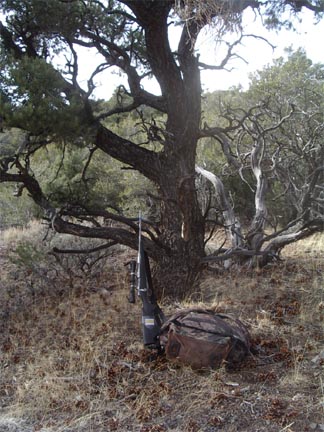
I pulled out and put on my waterproof coat in preparation for the evening sit, got out the rangefinder, took a couple of pics (like the one above), fired up a Salem, sipped some coffee, finally, after that hike and search for my look-out, turned around, and saw an elk walking down the pocket! 3:30.
Binocs up, ID certified. Brain hits high gear. Cigarette out, rangefinder and camera stuffed in my pockets, daypack zipped up and put on, rifle in hand, and I began to contour around to the gully. Twenty steps were enough to decide that I was dressed too warmly for such a hike, so I stopped, put down my rifle, took off my daypack, moved camera and rangefinder from coat pockets to vest pockets, took off the coat, stuffed it in the daypack, closed up the daypack, put it back on, picked up my rifle, and thought:
* The bull had just walked down, was in the bottom of the pocket; that was more distance covered than the other two sightings- was he going to settle in for eating, or was he perhaps going to head somewhere? I'd be out of contact for some time down in the gully, and certainly while cutting around in the trees on the other hill.
* The hill didn't have quite the contour/profile that I'd earlier thought. My view while crossing it wouldn't be as good as I'd figured.
* It looked like the gully curved way around to my right. I'd be forever getting across it while maintaining elevation, and already I was lower than the pocket.
* If I dropped down to cross, I'd have a heck of a climb to get above him. All the while being out of contact.
* Trying to climb to the correct zone without having the elk as a landmark would be difficult. I'd be in serious danger of walking into, boofing, him.
* It's opening day of elk season. I haven't a clue how many other hunters might be on the hill. I'd seen no activity, today or before, but the opener can be a whole new ball game. If I spend an hour bushwhacking, I might be 59 minutes too late.
That last was the clincher- I wasn't going to let this guy get away from me! No way!
Off with the daypack, out with the rangefinder, grab the rifle and crank up the scope, go prone, range the broadside bull at 417 yards, glance at my stock's drop cheatsheet, nestle in, hold just under the backline, fire. The bull gave a little jump and turned more towards me, and just as my finger tightened on shot 2 I think I saw him begin to crumple- fire. He went down and rolled a half roll, and was still. 3:35.
I stayed on the rifle, watched him in the binocs. Replenished my magazine. Lit a cigarette, and waited through it.
Took some pics through my binocs (I finally remembered to use them!):
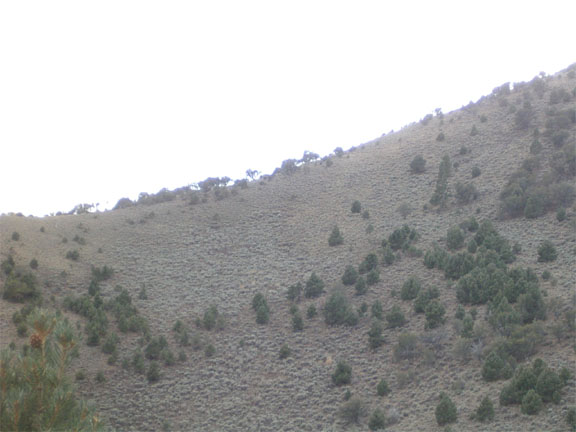
The elk is in the center of the picture, just above the line of trees.
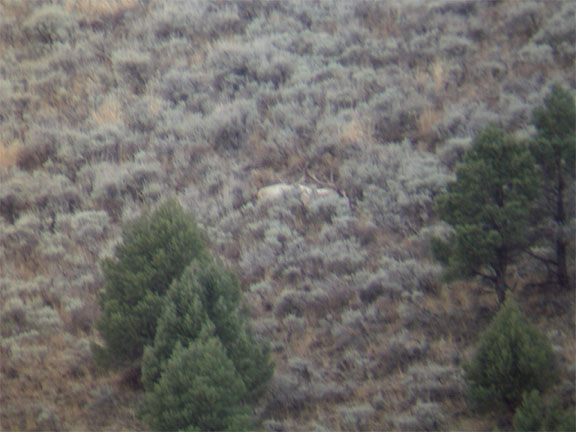
This is shot from the same point, through my binocs
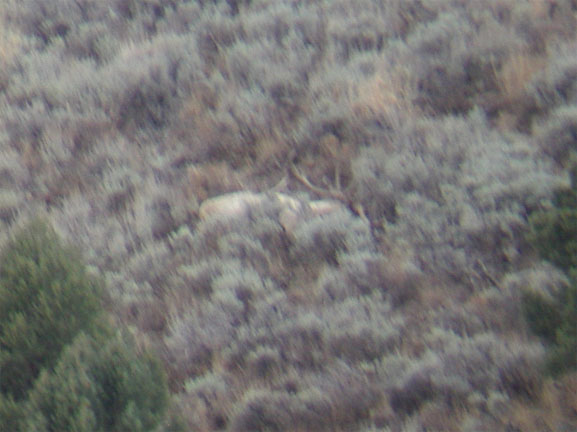
This is the same shot, magnified with Photoshop.
Then down my hillside and up the other, zig-zagging up through the sage, and came across a dead bull-- mine!
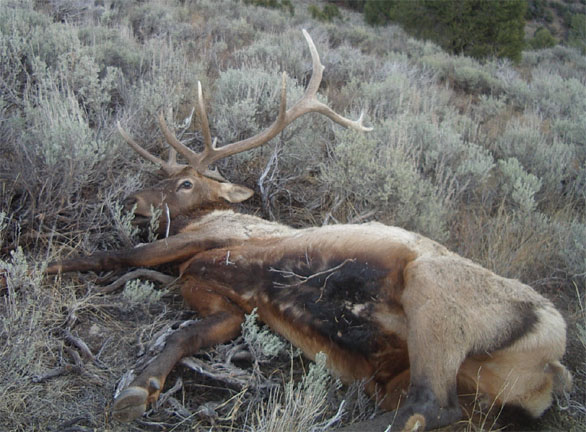
Dead at 3:35, I began the messy work at 4:30; dark at 6:00.
I pulled out Dad's Buck stockman's and began to do our usual. But on a bigger scale!
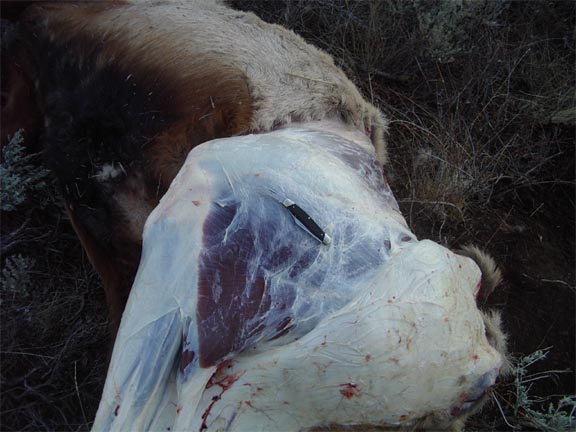
Had a nice musty, bull aroma. Never noticed any vermin.
He'd fallen almost perfectly for me (the only thing better would have been if he'd dropped six feet away, in a nice hollowed out bedding spot), perpendicular to gravity, laid out on his side. I've read of some of the predicaments elk have put hunters into-- it could have been a lot worse for me! His spine was right against the ground, not up as if he'd been lying exactly on his side, so that made those cuts a tight affair; and mainly because of that, I didn't rip all the way up his backbone first thing- I did the section I needed as I needed.
The knife's main blade wasn't as sharp as I'd thought, so it was more of a chore than it needed to be, and I eventually went to the very sharp (drew my own blood twice: not by clumsy cutting, but just by being clumsy swinging my hands around) Buck 110 from my survival buttpack belt for some of the work, especially the skin ripping. And elk skin is, I assure you, thicker than deer! I think I was able to cut up along the lower section of the legs like slitting an envelope, but the rest was a matter of: punch forward, yank up- and so advance an inch. Repeat... And the neck skin, especially, was tough. It was at least a half-inch thick.
Then there's the matter of weight. I now know that each hind weighed 60 pounds, without the lower attached. When one needs to get along the belly, to cut all the muscle and stuff and get to the joint, that leg has to be lifted out of the way. So one hand, or a shoulder, or several things together, is lifting most of 60 pounds and also straining against all of the attachment. And the leg is longer, so the reach is farther to it all. And there's so much more to cut- the lifting lasts much longer.
For this side, I was uphill and higher than the carcass, with it having a slight tilt to aid me. Wait until I turn the thing over, am below it all (and short me) reaching up, and the tilt is against me!
I usually leave the hoof on, to guarantee that I have the Achille's intact (I've lost it a few times by misjudging my joint cut) to hold, but this time I took it off first, to save lifting weight (5 pounds?). But still, there's no way I could make the final, freeing, cut while one-handedly holding up a good two feet of 60# leg! This is where the fairly thick, 6'x6' plastic sheet that I carry in my daypack proved worth all those days of carrying. Its secondary purpose is as an emergency shelter, but its primary is as a clean boning surface. This occasion found it needed earlier in the process- although rather clumsy, unfolded to 6x3 at first, as a 'table' among the sagebrush, I tucked it tight to the elk's butt, and, pushing the leg instead of lifting up, when the last cut was made just let the leg flop over and onto the plastic.
You know I pride myself on quartering extremely dirt-free. All that goes out the window when a 140-pound weakling is solo working a bull elk on the hillside! But my plastic saved me from having meat as coated as Kentucky Fried Chicken's Extra Crispy. A problem, though, was the slickness of the plastic, there on the slope and with sagebrush making other slopes- the quarters tended to slide off. But so it goes; one does what one can.
So, the first hind came off. It was a tight fit into the large 'elk bag' Mom had made out of some extra-thick material we found during a clean-up. I doubt that any of our regular deer bags are wide enough.
Then I did the front, dealing with the tough neck skin. And I misjudged how far back the scapula went, ended up cutting off a little of its trailing cartilage. It went into a deer bag. Or, most of it went into a deer bag-- I had about 9" of the shank sticking out; I just tied a closing cord around it and hoped for the best.
Then came the backstrap. At 15 pounds apiece, they're a handful! As I mentioned, the spine against the ground made for tight work; but I got it done. That went into its own deer bag.
(With deer, I usually put a hind and a backstrap in one bag, ditto the other side, and put both fores together in a third. Not so an elk!)
And that took me to 6:00. An hour and a half to do the basics of one side. And I was bushed.
It was nearly dark. I lugged the bags over to the nearest tree (the one at the right edge in this pic, I think):
Here's a look across the hill from the elk:
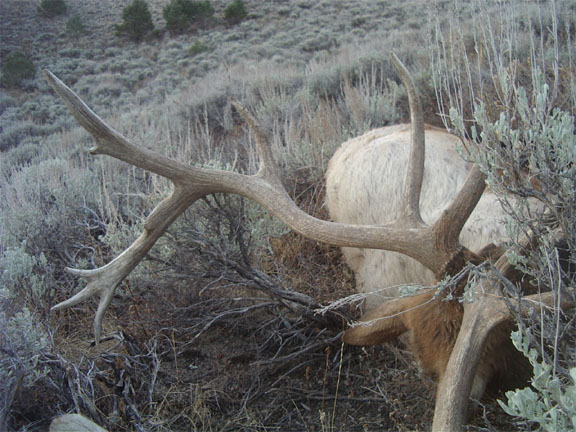
...and, with no suitable 'hanging branches', I set them on top of dead branches and leaning against trunk and branches such that they each had good airflow and were on the shady side. The smaller backstrap bag I was able to hang, though not even out of coyote reach.
I stood in indecision. Then put on my new for-this-trip headlamp (found that it didn't work well with a boonie hat, so put on my visored stocking cap- backward, homey), grunted and groaned enough to turn the carcass over, feet down on the hill, and began work on the other side's hind. This one was tougher, for the leverage, etc., reasons mentioned above, but happened nonetheless. I bagged it in my only other elk bag, and set it under the tree. No more indecision-- I was finished for the night.
All the pieces except the backstrap were out of my daypack's league, not to mention it was already pretty full, though now without the deer and elk bags and plastic sheet, so I stood in indecision again. But the thought, no matter how remote the possibility, that someone or something might make off with the antlers -the carcass easily visible in the sage hillside-, or gnaw on them, just wouldn't sit with me. To lose them! So, out with the knife again. I struggled once more with neck skin, finally removed the head in front of the first vertebra. ( I don't carry my bone saw in the daypack.) I cut out the tongue, put it in a plastic bag (my quarter bag bags also contain one each of gallon, quart, and sandwich Ziplocs, along with a few paper towels to wipe whatever needs wiping at the time) in my daypack, then I hacked off whatever I easily could, to save weight.
I wasn't going to be able to handle my rifle and the rack, too, so I went up to a tree higher on the hill than the meat and hung the rifle by its sling -muzzle down, magazine empty, and scope covers closed- against the trunk on the uphill side, quite invisible from the carcass site. And I tucked my plastic sheet with the quarters- no need to carry it down and then back up the next day.
Returned to the head, I put my last deer bag over the messy thing- it'd been drooling stomach liquid (not green mush) whenever I shifted it, and, of course, I'd bloodied it all up in the removal, etc. I put my pack back together, binocs inside, donned it, turned my cap rightway forward, policed the area, and then faced the puzzle- how to carry the rack. In that condition it weighed 50 pounds, and my daypack and buttpack come to about 20 pounds, so I had a full load. And a set of elk horns is not a compact unit! 50 pounds, 5 feet long, and two inches short of 4 feet wide.
I had to sit on the ground under it, like when putting on a very heavy pack. Several false starts later I was on my feet:
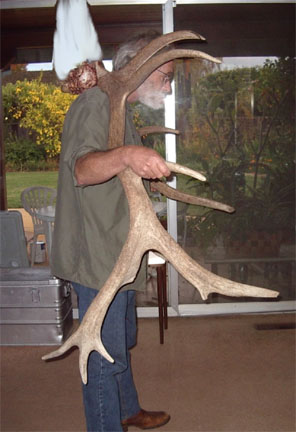
(How do you like the faux head I smudged in?)
So now it's down this hill:
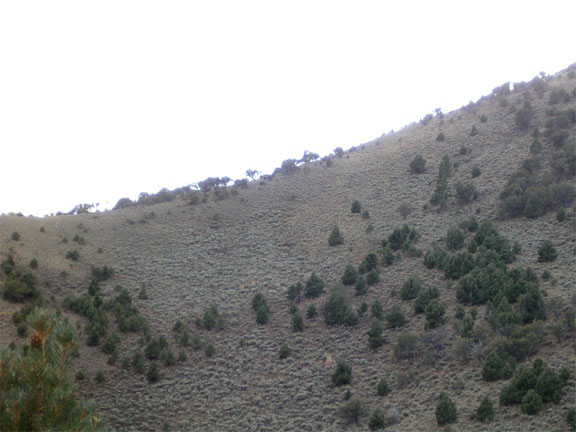
...in the dark, carrying 70 pounds, with hands occupied, unable to lift my head upright, with the head squooshing around the stocking cap that my headlamp is around. With tines forward and down, catching in the sagebrush.
I reached the bottom of the gully, and sat for a rest, letting the ground support some of the rack. I knew I wouldn't be able to get my "wide load" through the forest between me and the car; I was ducking and scraping as it was:
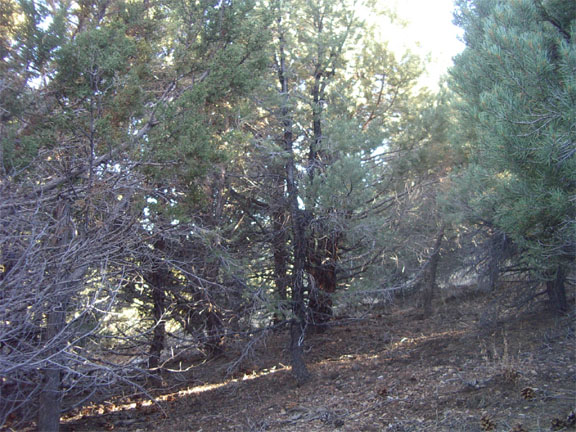
...especially in the dark, so I started right down the gully (part of my road to the area is directly below, as the topos I've sent in other emails show).
Talk about luck! Think of every wild, forest gully you've traveled: there're blow-downs and washdowns, bushes growing, waterfalls -even if dry-, etc. Well, this one isn't like that. In its upper section there were three long (5 ft) rock bottoms, but they were still walkable; two 'falls that I had to skirt by all of three feet; and one blow-down that forced me to move two feet. I never had a bottom less than two feet wide, usually it was at least six; and before long it was 20+, with nothing but sagebrush growing (although the sage was taller than the bottom of the antlers). Down where the slope was easier I began to run into trees, but they were sparser, and older and taller, than what I'd been hiking through all week. I left the left-curving, dry creek at some point to hit the road more directly. Certainly, I caught tines, to some degree, many times, but it could have been much, much worse. The Spot headlamp's beam was bright enough to see well enough ahead to plan an adequate route. Twice, I think, I had to swing the rack like a hammer to break off blocking branches, and there was one time when I just couldn't fit between two trunks, and had to back off and try again elsewhere. I fell only once, and then simply onto my butt, and had to walk on my knees once to clear some low-hanging branches. But for a mountain withdrawal, I had one that smelled like a rose! So what's it like for guys who get a trophy rack?!?!
I reached the road at 8:45, having rested four or five times. Believe me, I was glad to get that load off my neck, as well-shaped and -balanced as it was. I was also happy to no longer have the dirt from his scalp filtering down the back of my neck. And I could finally take off the too-hot stocking cap. And I was glad that the predicted rain hadn't shown up.
I left the rack against a tree well back from the road (still terrified of theft), marked my GPS, set one lightstick on a branch on one side of the road, and then, because the small, white lightstick didn't seem very bright (it was old, after all), I put a yellow one on the other side. I also set an old tin can on a small pile of rocks, just in case someone swiped my lights. I don't recall if I left my daypack there, but I'm sure I kept on my buttpack, my survival buttpack, and then I began walking the road to the Bronco.
Arrived there at 9:30. Drove out, for the last time on that dang branch-banging road. Found my spot (the large yellow much better than the small white), collected them as trash, and hauled out the antlers. And was, once again, in a pickle: no way they'd fit inside.
I got out the bag of extra rope that always goes with me camping, and tied the antlers behind the spare tire on my roof:
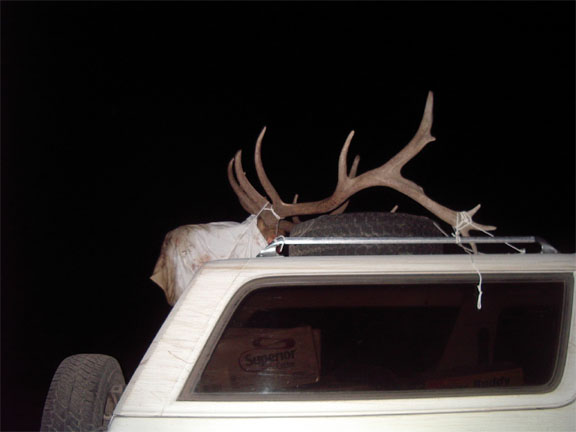
I drove back to camp slowly, with my window open (cold) the better to hear a clatter-drag. Popped one jackrabbit on the way.
Reached camp, without mishap, at 10:30. No mice in traps. I was bloodier than I'd ever before gotten from a cleaning, even though I used the 'gutless method'. Elk carry a lot of blood and their blood vessels are huge; many knife slices brought forth gushers. And the weight of each piece meant that I was hugging and wrestling with every one.
I started a fire, mainly for warmth (40 degrees at the time). For this one I used all of the biggest pieces of firewood I'd collected, the thick, main trunks of sagebrush (one 6 inches); I had a good roarer going. I bridged one side of the pit with the grate, got a pot of leftover coffee warming. Then added a pot to perk and my last can of chili.
I brought down the antlers and used my newly acquired Wyoming Saw II to cut off the front of the skull. I dug out the ivories:
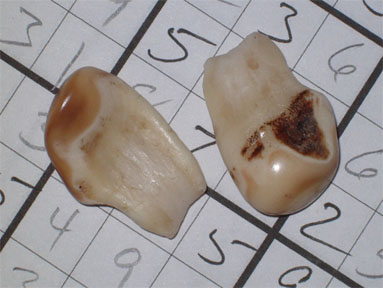
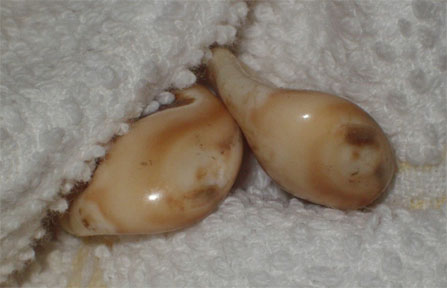
By then the big wood was gone, so I set the grate within the pit, and wondered why the coffee wasn't perking. Oh, I hadn't put in the basket of grounds.
While the chili finished warming I measured up the rack, somewhat dumbfounded at how low the score summed. But the antlers look so big, sitting there as a table centerpiece across the fire from me!
Ate at 12:10. Burned accumulated trash. Put the rack on Bronco hood, away from rodent teeth. Made a coctail from the last of the Wild Turkey; now had only the bottle of Jim Beam Rye I'd picked up in Ely.
Changed out of dirty clothes, so losing the benefits of my nice WindShear jeans.
Bed, a happy and tired guy, at 3:30.

David asked: Three weeks of nothing for deer and you get up at 9 am for elk, knowing there is one in your hunt area, and sleeping in! What??
What's the rush?
For one thing, I'm not an early riser. Getting up at 4:20, especially repeatedly, is difficult.
Since I already knew the way, I could have hiked up in the dark of morning (as I did the day before). Otherwise, in a strange area, I don't like to wander whither I don't know where, getting poked by whither I don't know what.
The morning hunt is usually pretty short. So there's the problem of the 'tween years, so to speak. Options- hike back to car and either go somewhere else or go to lunch, and then hike back in-- no thanks, doubling the hiking; or sitting in place napping as the flies (very few on this trip) and ants (more but not bad) allow, or reading, or twiddling thumbs-- I can do that, did the day before and the first of deer season, but even stolid I get the itchy-twitchies; or still-hunt elsewhere nearby for awhile-- which adds to hiking exhaustion, may well blow out some of the sources of the awaited feeding animals, and, really, is pretty futile anyway. So, I chose to try to get to my sits by about 3:00, the time when mulies seem to begin filtering out.
I saw the bull at the pocket, twice, in the afternoons (circular- I was mainly there in afternoons to do the seeing)(really, I was there all day one of those times). Maybe he has a bar-hopping circuit, and my 'pocket' is an afternoon affair.
David: I need a little bit of help understanding the lay of the land described below.
Let's make an analogy of Ronnie's Swale. You see a deer at the exclosure and want to stalk him.
To maintain your elevation, you'd have to walk around the hook at least as far as Leavitt's Roost in order to cross the gully without going downhill. And then it's back and through the trees of Oak Park before you'll have a shot. All that time with the deer out of view and no knowing what it's doing, where it might be headed, where it'll be as you're crunching under the oaks.
Or, move around to out of sight, go down and across the gully, and then have to climb up through either Oak Park or the backside of Ronnie's, depending on your choice, and have to guess where to stop climbing and start contouring in order to be at or above his level (trying to come up under an animal in the open is, I think, a low-odds option), still all out of 'contact' with the deer.
It'd be easier to judge at our familiar ranch, not so much out there in NV.
Next: The trophy shots.