Oregon Hunt 2014
Page Two Sunday October 12
First posted October 21, 2014 Last edited October 21, 2014

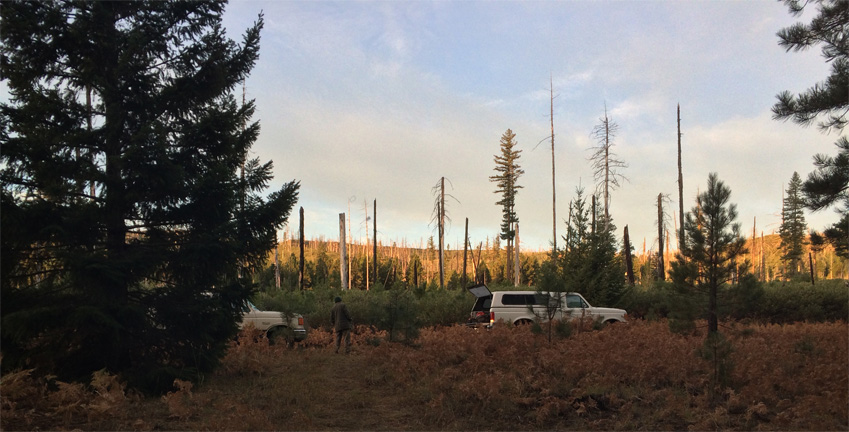
Sunday's sunrise
Craig packed up Sunday, the next morning. Bill and I helped him to strike the Cook Tent and load his truck. Trying to be helpful, I put a rock in his truck. Craig saw it and took it out. I chucked it into the bushes, and as he drove away, asked him if he had found where I put the rock back in his truck. Bill saw it all, and we hoped that Craig worried about that rock all the way back to Reno. What are hunting buddies for?
A word about the area we were hunting. A fire, called the Bear Butte and Booth Fire, or B&B Fire, burned through 90,000 acres of this region in 2003. It was caused by lightening and while it was fought to the tune of $38 million, it basically burned until rain put it out.
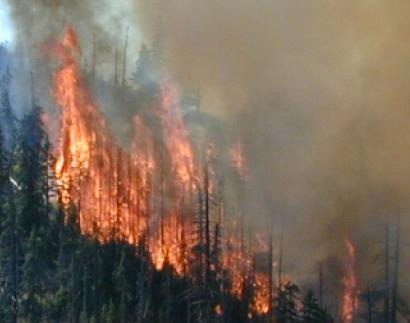
The fire had the typical hop-scotch pattern of most wild fires, with some areas being burned to the bare earth and other areas being completely spared. We were camping in an small area that was spared, just a few acres, but surrounded by burn. Where the fire burned rather hot, it left only standing dead pines. In the 11 years since, the underbrush has gone into overdrive: with no competition, plenty of sunlight, and ash for fertilizer,it grew like mad. The main underbrush is a native plant called snowbrush ceanothus, Ceanothus velutinus. This brush creates a large amount of seed, with a 200 year lifetime in the seedbank. It typically needs fire to stimulate it to sprout. Well, it sprouted with a vengence in our hunt area, to our eternal frustration and regret. It facilitates its growth by having nitrogen-fixing bacterial in its roots, so when it grows, it grows gangbusters, which all four of us can attest to.
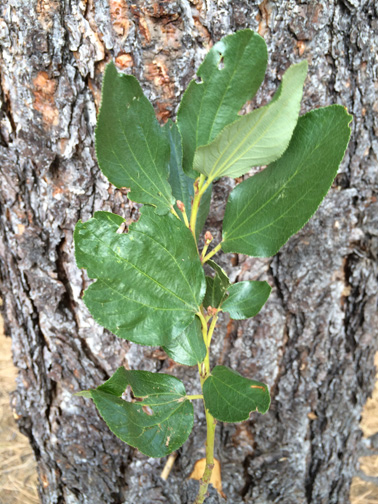
The leaves are bright green on top, slightly yellow green on the bottom, about 3 inches long. When crushed, they have a faint vanilla smell, which we all noticed. Bill could smell them when the air was moist and the sun heated them up. They tended to grow upright, with only moderate interweaving of branches, and are flexible. This makes it somewhat possible to wade through a patch of it, but not always and never easily.
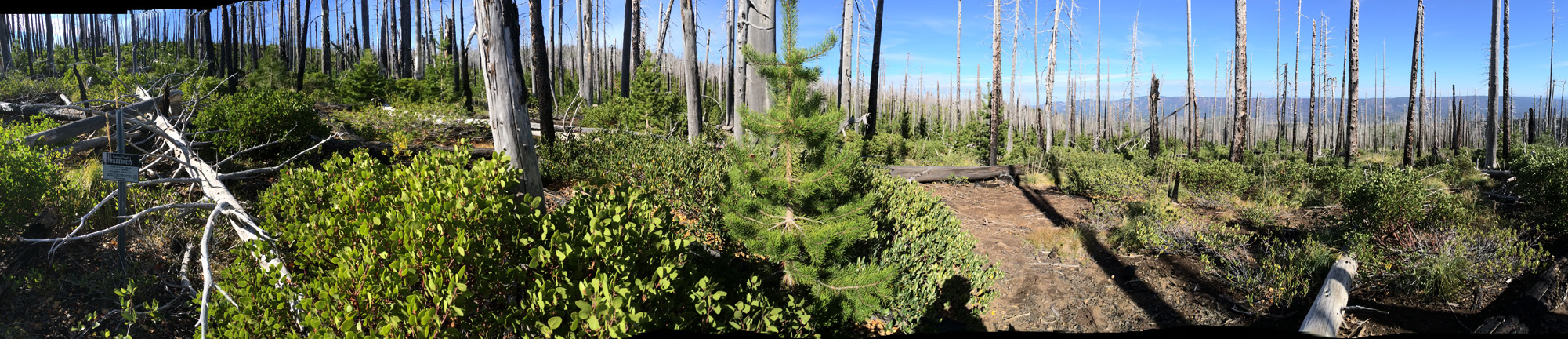
(In the image above, scroll to the right to see it all.)
This gives a pretty good idea of many of our hunt areas. There are many standing dead pines, blocking out distance shots. When the snowbrush grows in small clumps, you do the sage-sashay, dodging around it. There always seems to be a clump directly in the line you want to walk in, and you often find yourself scrambling over deadfalls in an attempt to avoid the snowbrush. You struggle.
When it grows in thickets, it usually forms an almost impenetrable barrier. Where you can get around it, you do. Where you can't, you try to find a way to fight through it, and you struggle even more. We did find some places where the deer seemed to have nibbled the snowbrush, but mostly they seem to ignore it. This allows it to grow over all paths and even over unused roads, making them impassable. It was quite frustrating.
Bill was not feeling well and was nursing a sore tooth. He had seen a dentist in La Pine, Oregon, (see map on Page One), was on antibiotics and Tylenol, and was scheduled to get it pulled after the season. So you need to cut him some slack. However, if the truth be told, he is lazy and has not gotten up for the morning hunt throughout deer season at the Ranch or in Arizona last year. I liked his laziness and did not ever get up at 4 am in the darkness, the way Craig and Ted did.
I was fresh in camp, had not gotten frustrated with the snowbrush, and so wanted to hunt before Bill got up. I got up at 9 am or so, decided to try staying in the mature forest that we were camped in and that had not burned. I had seen some of the snowbrush ceanothus at the edge of camp and knew it was impenetratable.
Here is a topo map and a Google satellite image of the same area.
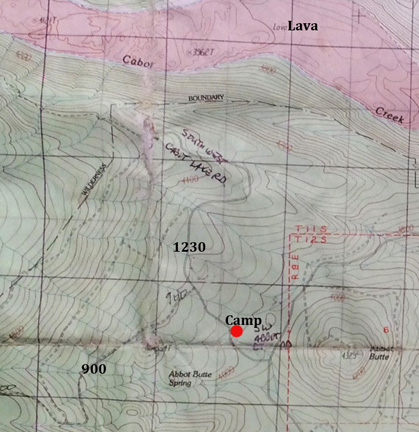
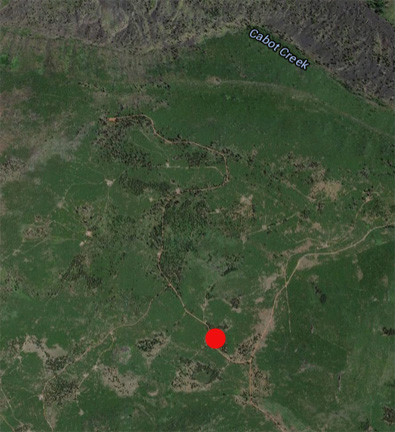
You can see on the right hand map that the red dot marking camp is in a slight area of dark green, which is mature forest. The lighter green is snowbrush, the tan is grass.
I had found a path through the camp area, and followed it south-east. I used my Garmen GPS to lay a track, so that I could find my way back to camp. The forest was thick for about 750 yards, then thinned out. The road you can see in the above maps, heading north-east, came into view. Road hunters (guys who never get out and walk, but just drive slowly up and down the roads; this is illegal) would pass by every hour or so, and I would just hunker down and they would pass without seeing me.
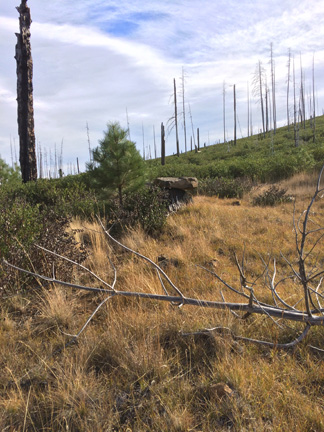
The photo above is what I soon found myself in. The land rose up on my right, going up Abbot Butte. There were the typical dead pines and a forest of snowbrush so thick I could not walk through it. There was a bit of grass along the road, along with deadfalls. The snowbrush was impassable, so that left me walking along the road. Once, while I was kneeling behind a stump reading my topo map, I looked up and found a doe and fawn walking about 50 feet from me. They did not notice me at all, but were just intent in looking ahead. While they did not have forks, it certainly seemed like a good omen.
I found a place where I could go up the grassy slope about 75 feet, which gave me about a 15 foot rise over the local area, found a comfortable place to sit, and watched whatever openings I could find in the snowbrush. I did see two pairs of does and fawns, but as soon as they left the grassy opening in which I spotted them, they disappeared in the 6 foot tall snowbrush.
Bill and I had arranged to talk at noon by walkie-talkie, but he did not answer. I stayed until about 1 pm, then traced my way back to camp.
Back to Page One This is Page Two Page Three Page Five